
Understanding SEO for Answer Engines: Core Differences and Evolution
In October 2026, the digital landscape has fundamentally transformed. We are rapidly moving from traditional search engine results pages (SERPs), where clicks were the primary goal, towards a future dominated by direct answers. Users now expect instant, accurate responses delivered by generative AI, voice assistants, and AI Overviews.
This shift represents both a significant challenge and a massive opportunity. Consider these realities: Google’s AI Overviews are now present in roughly 50% of queries, a figure experts anticipate reaching 75% by 2028. Additionally, around 60% of all searches are now “zero-click,” meaning users find their answers directly without ever visiting a website.
This evolution demands a new approach to digital visibility: Answer Engine Optimization (AEO). AEO is all about ensuring our content is not just found, but directly understood, utilized, and cited by these intelligent systems. For a deeper understanding of this crucial shift, you can explore what SEO for answer engines entails.
In this comprehensive guide, we will explore the core concepts of AEO, differentiate it from traditional SEO, and explain why it has become indispensable for brands today. We will delve into the fundamental pillars of an effective AEO strategy, uncover the mechanics of how answer engines select and cite content, and provide practical steps to structure and optimize your content for generative AI. We’ll also discuss key performance indicators (KPIs) and address the potential risks and challenges of this evolving domain.
The digital world is no longer just about keywords and backlinks; it’s about context, intent, and direct answers. Generative search engines, powered by sophisticated AI, don’t merely present a list of links. Instead, they actively interpret user queries, parse vast amounts of information, and synthesize concise, relevant answers. This fundamental shift means our content must be machine-readable and semantically rich, allowing AI to extract meaning, identify entities, and establish authority. It’s a move from simple keyword matching to a deeper understanding of information, where content needs to be structured for machine comprehension rather than just human consumption. This is the essence of optimizing for answer engines, a discipline that extends beyond traditional SEO to ensure our digital assets are not just visible, but truly intelligible to AI.
How SEO for Answer Engines Differs from Traditional Search
Traditional SEO has long focused on achieving the coveted #1 organic ranking, primarily to drive clicks to a website. The success metrics revolved around traffic volume and keyword positions. However, the rise of answer engines has introduced a new paradigm. Our goal now often shifts to “Position Zero” – the direct answer box, featured snippet, People Also Ask (PAA) section, or AI Overview that appears prominently at the top of search results.
This change is profound. Instead of aiming for a click, we are now optimizing to be the answer. This means AI engines are performing “passage extraction,” pulling specific, relevant sections of our content to directly answer a user’s query, often without the user ever needing to visit our site. Statistics underscore this shift: organic click-through rates on queries accompanied by Google AI Overviews have plummeted by 57%. With zero-click searches now accounting for approximately 60% of all queries, the emphasis is less on driving raw traffic and more on ensuring our brand is the authoritative source cited in these direct answers. This demands a focus on user intent, crafting content that directly and concisely addresses specific questions, rather than broad keyword targeting.
Comparing Traditional SEO, GEO, and AEO Frameworks
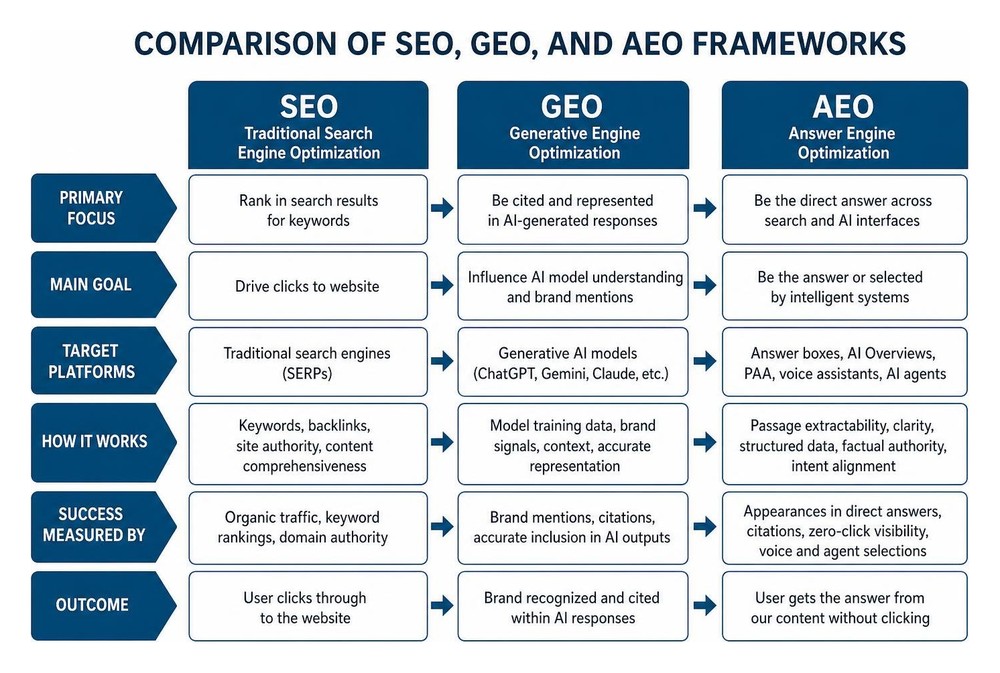
To fully grasp the landscape of modern digital visibility, it’s crucial to differentiate between three interconnected but distinct optimization frameworks: Traditional SEO, Generative Engine Optimization (GEO), and Answer Engine Optimization (AEO). While they share common ground, their primary targets and mechanisms for achieving visibility differ significantly.
Traditional SEO focuses on optimizing websites to rank highly in organic search results for specific keywords. Its primary goal is to drive clicks to a website, with success measured by organic traffic, keyword rankings, and domain authority built through backlinks and comprehensive content.
Generative Engine Optimization (GEO) emerged as Large Language Models (LLMs) became central to conversational AI interfaces like ChatGPT, Gemini, and Claude. GEO aims to ensure our brand and content are accurately cited, summarized, and discussed within these generative AI responses. It’s about influencing the “model memory” – the training data LLMs use – and ensuring our expertise is recognized when AI synthesizes information. GEO prioritizes brand mentions and accurate representation within AI-generated narratives.
Answer Engine Optimization (AEO) is a broader concept that encompasses both GEO and the optimization for direct answers in traditional search interfaces (Position Zero, Featured Snippets, PAA, AI Overviews) and voice assistants. AEO’s ultimate goal is to be the answer or to be selected by autonomous agents making decisions on behalf of users. It focuses on extractability, clarity, and factual authority, ensuring our content is the definitive source for a specific query. This includes optimizing for voice search queries, which are often longer and more conversational, and preparing content for future “agentic commerce,” where AI agents might autonomously select and purchase products or services based on structured data.
These three frameworks are not mutually exclusive; rather, they are cumulative. A strong SEO foundation is essential for content discovery and authority. GEO builds on this by ensuring AI models accurately understand and cite our brand. AEO then refines content for direct answerability and selection by intelligent systems.
The Mechanics of How Answer Engines Retrieve and Synthesize Information
Understanding how modern answer engines operate is paramount to effective AEO. These systems, primarily driven by Large Language Models (LLMs), don’t simply “read” a webpage in the human sense. Instead, they employ sophisticated processes like Retrieval-Augmented Generation (RAG) to construct their answers. When a user poses a question, the LLM doesn’t just generate a response from its internal training data. It first retrieves relevant information from an indexed corpus of web content and other data sources. This retrieved information then “grounds” the LLM’s generation, ensuring the answer is factually accurate and up-to-date. This process relies heavily on how well our web content is structured and indexed, allowing the AI to efficiently find, understand, and utilize specific passages to form its comprehensive, synthesized response.
Chunk-Level Retrieval and Passage Extractability
One of the most significant shifts in how AI processes web content is the move from whole-page ranking to “chunk-level retrieval.” Instead of evaluating an entire webpage for relevance, generative AI engines break down pages into smaller, autonomous “chunks” or passages. Each of these chunks is then independently assessed for its semantic coherence, relevance to a query, and potential to serve as a direct answer.
For us, this means that every paragraph, list, or table should ideally communicate a single, complete idea that can stand alone without requiring extensive surrounding context. We need to optimize for “passage extractability.” Clear content hierarchy, using descriptive H2 and H3 headings, helps AI identify these modular sections. The optimal length for these direct answer blocks often falls within a concise 40-60 words, ensuring they are easily digestible by both AI and users. By structuring our content in this modular fashion, we increase the likelihood that specific, high-value information will be extracted and cited by answer engines.
Multi-Source Triangulation and Verification Signals
Answer engines prioritize accuracy and trust. To achieve this, they don’t rely on a single source for an answer. Instead, they engage in “multi-source triangulation,” cross-referencing information from various websites, databases, and user-generated content to verify facts and build a comprehensive understanding. This process amplifies the importance of factual density within our content and the verifiability of our claims.
Beyond direct links, AI models also consider “unlinked mentions” across the web – references to our brand, products, or expertise on social media, forums, review sites, and news articles. These unlinked mentions contribute significantly to our overall “digital footprint” and signal to AI that our brand is a recognized entity. Consistent entity naming across all digital assets reinforces our “brand reputation” and helps AI connect disparate pieces of information. The more consistently and authoritatively our brand is discussed and cited across a diverse range of credible sources, the more likely answer engines are to trust and feature our content in their synthesized responses.
Structural Blueprint: Optimizing Content for Direct Extraction
To effectively optimize for answer engines, we must fundamentally rethink how we structure our content. The goal is to make our information not just readable for humans, but also highly “extractable” for AI systems. This involves adopting a modular architecture where key pieces of information are clearly defined and easily identifiable. We need to move beyond traditional prose and embrace formats that lend themselves to machine parsing, such as scannable lists, tables, and concise, direct statements. Implementing a robust “semantic markup” strategy, including schema validation, is crucial to explicitly communicate the meaning and relationships within our content to AI. By building this structural blueprint, we ensure our valuable insights are readily available for direct extraction and synthesis by generative AI.
Formatting Answer-First Blocks and Decision Tables
For content to be readily consumed by answer engines, it must be presented in an “answer-first” format. This means placing the most concise, direct answer to a question immediately at the beginning of a section, typically right after a question-based heading. Research suggests that an optimal length for these direct answer summaries is between 40 and 60 words, making them ideal for quick extraction by AI.
Furthermore, when presenting comparative data or information that aids decision-making, using native HTML tables is far more effective than embedding text within images or complex paragraph structures. AI engines can easily parse well-formatted tables, extracting specific attributes, features, or pricing points. This allows generative AI to synthesize clear comparisons or recommendations directly into its answers. By front-loading key takeaways and utilizing clear, structured HTML formatting for lists and tables, we significantly enhance the extractability of our content.
Technical Infrastructure and Semantic Schema Markup
Beyond clear on-page formatting, the underlying “technical infrastructure” of our content plays a critical role in AEO. This primarily involves the strategic implementation of “semantic schema markup” using JSON-LD. Schema.org vocabulary provides a standardized way to explicitly define entities, relationships, and content types to search engines and AI.
While schema alone doesn’t guarantee a Position Zero spot, it significantly improves an AI’s ability to accurately interpret and categorize our content. Key schema types for AEO include:
- FAQPage: For pages containing a list of questions and answers, directly signaling Q&A pairs to AI.
- HowTo: For step-by-step guides, making processes easily extractable.
- Organization: To define our brand, its official name, and key identifiers.
- Article: To specify the type of article (e.g., NewsArticle, BlogPosting) and its key attributes.
- Speakable: A less common but emerging schema that identifies sections of content suitable for text-to-speech, relevant for voice assistants.
It’s vital that the schema markup precisely reflects the visible content on the page. Any discrepancies can confuse AI and negate the benefits. Treating schema as essential infrastructure rather than a mere add-on ensures that our content is not just seen, but deeply understood by the intelligent systems that power modern search.
Advanced Content Architecture and Maintenance
Achieving sustained AEO visibility requires more than just one-off optimizations; it demands a sophisticated and continuous approach to content architecture and maintenance. We must move towards building comprehensive “topic clusters” that demonstrate deep expertise and semantic authority around core subjects. This involves meticulously mapping conversational prompts and buyer journeys, ensuring our content addresses every nuance of a user’s potential query. Maintaining “entity clarity” – consistently defining and referring to key concepts, products, and our brand – is crucial for AI comprehension. Furthermore, we need to actively manage “freshness signals,” recognizing that AI prioritizes up-to-date information, especially in rapidly evolving industries.
Technical Workflows of SEO for Answer Engines Across Modern Platforms
The technical workflows for AEO are becoming increasingly complex, extending beyond traditional website optimization. We need to understand how “conversational prompts” evolve throughout a “buyer’s journey” and ensure our content addresses these multi-step queries. For instance, a B2B buyer might start with a broad question (“best CRM software”), then filter by compliance (“HIPAA compliant CRM”), then by integration (“CRM with Salesforce integration”), and finally by sentiment (“CRM reviews Reddit”). Our content architecture must anticipate and answer these progressive prompts.
AI agents rely on sophisticated “knowledge graphs” to connect entities and provide comprehensive answers. This means our content should not just be about keywords, but about establishing clear relationships between concepts. Crucially, we must ensure “crawler accessibility” for all relevant AI bots (e.g., GPTBot, ClaudeBot, PerplexityBot, GoogleExtended) through our robots.txt files. Server-side rendering (SSR) for critical content is also paramount, as client-side JavaScript rendering can hinder AI crawlers from fully indexing our pages.
Information Durability and Content Refresh Cadence
In the world of AI-driven search, “information durability” is key. AI models prioritize fresh, accurate data. Our “first-party data” and original research become invaluable assets, as LLMs often cite the original source of unique insights. This creates a “citation moat” that competitors cannot easily replicate.
A rigorous “content refresh cadence” is no longer optional. Pages that are not updated quarterly are three times more likely to lose their AI citations. For “volatile topics” like AI tool comparisons, product pricing, or industry news, a refresh cycle of 30-90 days might be necessary. Regular “quarterly audits” are essential to ensure data consistency across all our digital properties, preventing AI from hallucinating incorrect information due to outdated external mentions. By prioritizing freshness and original data, we build a more resilient and authoritative presence in answer engines.
Measurement, Attribution, and KPI Tracking in AI Search
The shift to answer engines necessitates a complete overhaul of how we measure success and attribute value. In a world dominated by zero-click searches, traditional metrics like organic clicks and keyword rankings, while still relevant for foundational SEO, no longer tell the full story of our brand’s AI visibility. We need to focus on metrics that reflect our presence in direct answers and AI-generated summaries. Our “attribution models” must evolve to account for “zero-click engagement” and the indirect, yet powerful, impact of being cited by AI. The goal is to connect AI visibility to tangible business outcomes, such as qualified leads and “pipeline value,” even if the user never directly clicked through to our website.
Essential AI Visibility and Citation Metrics
To accurately gauge our AEO performance, we need to track a new set of “essential AI visibility metrics”:
- Citation Rate: How often our content or brand is directly cited by various AI answer engines (ChatGPT, Gemini, Perplexity, AI Overviews). This is a primary indicator of AEO success.
- Brand Mentions: The frequency and sentiment of our brand being mentioned in AI-generated answers, even if not a direct citation.
- Share of Voice (SoV) in AI Answers: Our brand’s presence in AI answers compared to competitors for key queries.
- Query Fan-out: How many different user queries or prompt variations lead to our content being cited or mentioned by AI.
- Candidate Rankings: For queries where we don’t yet have a direct AI answer, tracking if our pages appear in the top 3-10 organic results, making them “candidate” sources for future AI extraction.
Tools are emerging to help monitor LLM citations and brand mentions, providing insights into which platforms are citing our content and for which queries.
Tracking High-Intent Conversions and Business Impact
While zero-click searches might reduce direct website traffic, the traffic that does come from AI answer engines is often of significantly higher intent. Visitors originating from AI search convert at rates 4.4 times better than traditional organic search traffic, with some reports even suggesting 23 times higher conversion rates. This indicates that AI-generated answers pre-qualify users, delivering them to our site with a clearer understanding of their needs and our offerings.
Our “attribution models” need to account for “multi-session journeys” and “assisted conversions” where AI played an early role in the discovery process. Integrating AEO insights with our CRM is crucial to track “qualified pipeline” and understand the true business impact. This means identifying leads that initiated their research through AI interactions and attributing a portion of their value to our AEO efforts. We must recognize that the “no-click” effect doesn’t mean no value; it means the value is shifting from raw traffic to pre-qualified engagement and brand authority established at the earliest stages of the buyer’s journey.
Frequently Asked Questions About Answer Engine Optimization
Does Answer Engine Optimization replace traditional SEO?
No, Answer Engine Optimization does not replace traditional SEO; rather, it acts as a complementary and essential extension. Traditional SEO remains the foundational layer, ensuring our website is technically sound, crawlable, indexable, and possesses overall domain authority through backlinks and comprehensive content. These “technical foundations” are crucial for AI engines to even discover and evaluate our content. AEO then builds upon this, optimizing content specifically for direct answers, featured snippets, voice search, and generative AI citations. Think of it as a “hybrid visibility” strategy: SEO gets us found, and AEO ensures we are the definitive answer. Without a strong SEO base, our AEO efforts will struggle to gain traction, as AI models still rely on the underlying quality and authority signals that SEO provides.
How quickly do AI answer engines reflect content updates?
The speed at which AI answer engines reflect content updates can vary. Structural adjustments to content, such as clear question-based headings and concise answer blocks, can be recognized by AI crawlers and influence “retrieval cadence” within a few weeks. For real-time citations and inclusion in dynamic AI Overviews, the impact can be seen relatively quickly if the content is highly relevant and authoritative. However, for deeper integration into an LLM’s “model training” data, which influences its core knowledge and “prompt caching,” the timeframe can be longer, typically ranging from 6 to 18 months. To maintain “sustained visibility,” a proactive “90-day refresh” cycle for high-value content is often recommended, especially for volatile topics or industry-specific data that changes frequently.
What structured data schemas are most critical for answer engine visibility?
While all relevant Schema.org markup can be beneficial, several “structured data schemas” are particularly critical for enhancing answer engine visibility:
- FAQPage Schema: Ideal for pages that list questions and their corresponding answers, directly signaling Q&A pairs to AI.
- HowTo Schema: Perfect for step-by-step guides, allowing AI to easily extract instructions.
- Article Schema: Helps define the content as an article, including attributes like author, publication date, and headline.
- Organization Schema: Crucial for defining our brand as a “structured entity,” including its official name, logo, and contact information, building trust and authority.
- Product and SoftwareApplication Schema: Essential for e-commerce and SaaS businesses to provide detailed specifications, pricing, and reviews in a machine-readable format.
Implementing these schemas accurately, ensuring they precisely match the visible content on the page, significantly improves an AI’s ability to understand, categorize, and cite our information.
Conclusion
The evolution of search from keyword ranking to “conversational discovery” marks a pivotal moment in digital marketing. Answer Engine Optimization is not merely a trend; it’s the strategic imperative for brands aiming for “sustainable visibility” in an AI-first world. We’ve seen that success now hinges on “machine readability” and “factual authority,” ensuring our content is not just found, but directly understood, synthesized, and cited by intelligent systems. By embracing AEO’s principles – from structuring content in extractable chunks and implementing robust schema to prioritizing freshness and measuring new metrics – we can navigate this new landscape. The future of search is here, and it demands that we adapt our strategies to speak the language of AI, securing our place as the definitive answer in every user’s query.