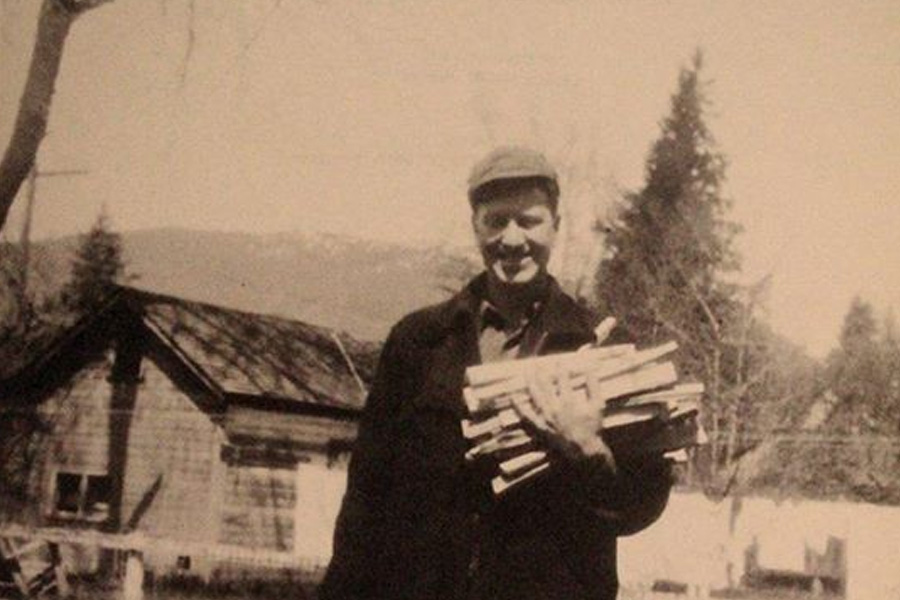
A Montana Beginning
I see Donald Walton Lynch as a man shaped by distance, discipline, and duty. His life begins in Montana, in the hard bright country where the land teaches patience before it teaches comfort. He was born on December 4, 1915, and grew up on a family farm that did not yet have the ease of modern life. No electricity. No running water. Just work, weather, and the long silence of open land. That kind of childhood can leave a person lean and sturdy, like a pine trunk forced to grow straight in a narrow valley.
His parents were Austin E. Lynch and Maude Sullivan Lynch. Their household also included his sisters, Margaret Turner and Nonie Krall. The family line matters here because Donald’s life was never just his own. He carried a family name through war, science, marriage, and parenthood, and that name kept branching outward like roots under packed soil.
Education, War, and the Shape of Service
Donald Walton Lynch attended the University of Montana, a step that moved him from rural beginnings into formal study. Education gave him a new language, but it did not erase the older one he had learned from the farm. He understood labor, weather, and practical problem solving long before he learned how to write them into a career.
Then came World War II. Donald served four years in the U.S. Navy, reached the rank of lieutenant, and served as chief engineer on the destroyer USS Mugford. That is a demanding kind of responsibility. An engineering officer at sea lives close to risk, machinery, and time. Every valve matters. Every decision has weight. In war, there is no room for decorative thinking. A ship is a machine and a promise, and Donald helped keep that promise intact.
After the war, his life did not drift. It deepened.
A Career in Forestry That Looked Like Precision
Donald received a Duke University forestry PhD in 1955. That milestone introduced him to measurement, planning, and long-term goals. Forestry is not for instant gratification seekers. People who think in decades can count tree rings.
After 28 years with the Forest Service, he retired in 1973. He studied timber management, site measurement, yield, and second-growth ponderosa pine logging effects. This field suits a man who moved from farm to ship to woodland. He investigated biological systems that had to withstand pressure like him.
His publications covered sampling in tree measuring sales, ponderosa pine growth on best sites, logging damage under severe cutting, silvics, and stocking impacts on site measurement and yield. Technical topics, but the aim is simple: he helped people understand forests, which is the first step to stewardship.
Forest Service research on wood management and pest and disease research was led by him. That kind of position implies trust. He wasn’t only a researcher to colleagues. They recognized him as someone who could see the big picture without losing detail.
Edwina, the Center of the Family
Donald married Edwina Sundholm Lynch, often remembered as Sunny, in 1945. Their marriage lasted nearly six decades. That alone tells a story. A long marriage is not a single sentence. It is weather, repair, humor, compromise, memory, and momentum. It is the daily turning of the same key in the same door.
Edwina was not simply a spouse in the background. She was a central part of the family structure, the still point around which the household moved. Together, Donald and Edwina raised children, built a home, and carried the family through a century that changed everything from transportation to communication to the shape of American life.
Edwina died in 2004, and Donald followed in 2007. Their names remain linked, as they should be, because some lives are best understood in pairs.
Children: Three Distinct Lives from One Household
Donald and Edwina had three children: David Lynch, John Lynch, and Martha Lynch Levacy. Each child carried a different branch of the family tree into the future.
David Lynch became the most publicly known of the three, later recognized as a filmmaker, artist, and cultural figure. But in the family story, he was first a son of Donald and Edwina, born into a household shaped by discipline, travel, and Montana memory. David’s later creativity does not cancel the father’s influence. If anything, it suggests a home where observation, patience, and attention were part of the air.
John Lynch is identified as one of Donald and Edwina’s children and is associated with his wife Denise. He represents a quieter continuation of the family line, one less exposed to public attention but no less essential to the full family picture.
Martha Lynch Levacy is the third child, identified with her husband Ronald. Like John, she helps complete the family structure in a more private register. Not every branch needs a spotlight to matter. Some simply hold the shape of the tree.
Grandchildren and Great-Grandchild
Donald’s obituary names Jennifer, Edward, Steven, Andrew, Austin, Michael, Robert, Patrick, and Riley as grandchildren. I see this generation as a circle spreading. A forester would understand how family rings preserve a year of life.
Later allusions to the family include Austin Jack Lynch and Riley Lynch, David Lynch’s children. In modern family coverage, Jennifer Lynch is also identifiable. Sydney Lynch is another great-grandchild. Lula Boginia Lynch is a younger family member. The family branch has grown, and each name feels like a memory diary, carrying a bit of the older story.
The Public Trace of a Private Man
Donald Walton Lynch was never built for celebrity, but the public record still shows a full life. He was a veteran, scholar, scientist, husband, father, grandfather, and great-grandfather. He lived long enough to see his son David become famous, but his own life did not need that fame to stand upright.
He died in Riverside, California, on December 4, 2007, the same day of the month as his birth, which gives his life a closed circle, neat as a tree ring. He was buried with military honors at the Riverside Veterans Cemetery. That detail feels right. He began in the rough country of Montana and ended under a stone that acknowledged service, country, and endurance.
Family Timeline
| Year | Event |
|---|---|
| 1915 | Born in Montana |
| 1945 | Married Edwina Sundholm Lynch |
| 1940s | Served in the U.S. Navy during World War II |
| 1946 | Son David Lynch was born |
| 1955 | Earned doctorate in forestry from Duke University |
| 1973 | Retired from the U.S. Forest Service |
| 2004 | Edwina Lynch died |
| 2007 | Donald Walton Lynch died |
FAQ
Who was Donald Walton Lynch?
Donald Walton Lynch was an American Navy veteran, forestry scientist, and U.S. Forest Service researcher. He also became known as the father of filmmaker David Lynch. His life moved from a Montana farm to military service to academic research, with each chapter built on the last.
Who were Donald Walton Lynch’s family members?
His parents were Austin E. Lynch and Maude Sullivan Lynch. His sisters were Margaret Turner and Nonie Krall. His wife was Edwina Sundholm Lynch. His children were David Lynch, John Lynch, and Martha Lynch Levacy. His descendants included multiple grandchildren and at least one great-grandchild named Sydney.
What kind of work did Donald Walton Lynch do?
He worked in forestry research, especially on ponderosa pine, timber management, site measurement, yield, and logging effects. He also served in a leadership role within Forest Service research. His work was careful, technical, and long range, like tending a forest one measurement at a time.
Why is Donald Walton Lynch remembered?
He is remembered both for his own professional life and for his place in a notable family line. He was a wartime officer, a scholar, a forestry specialist, and the father of David Lynch. That combination gives his life a quiet weight.
What is known about Donald Walton Lynch’s marriage?
He married Edwina Sundholm Lynch in 1945, and they remained married for nearly 60 years. Their partnership formed the core of the family and carried through the raising of their three children.
Where did Donald Walton Lynch come from?
He was born in Montana and raised in a rural environment on a family farm. That setting shaped his early life and likely helped form the practical mind that later guided his military and research careers.