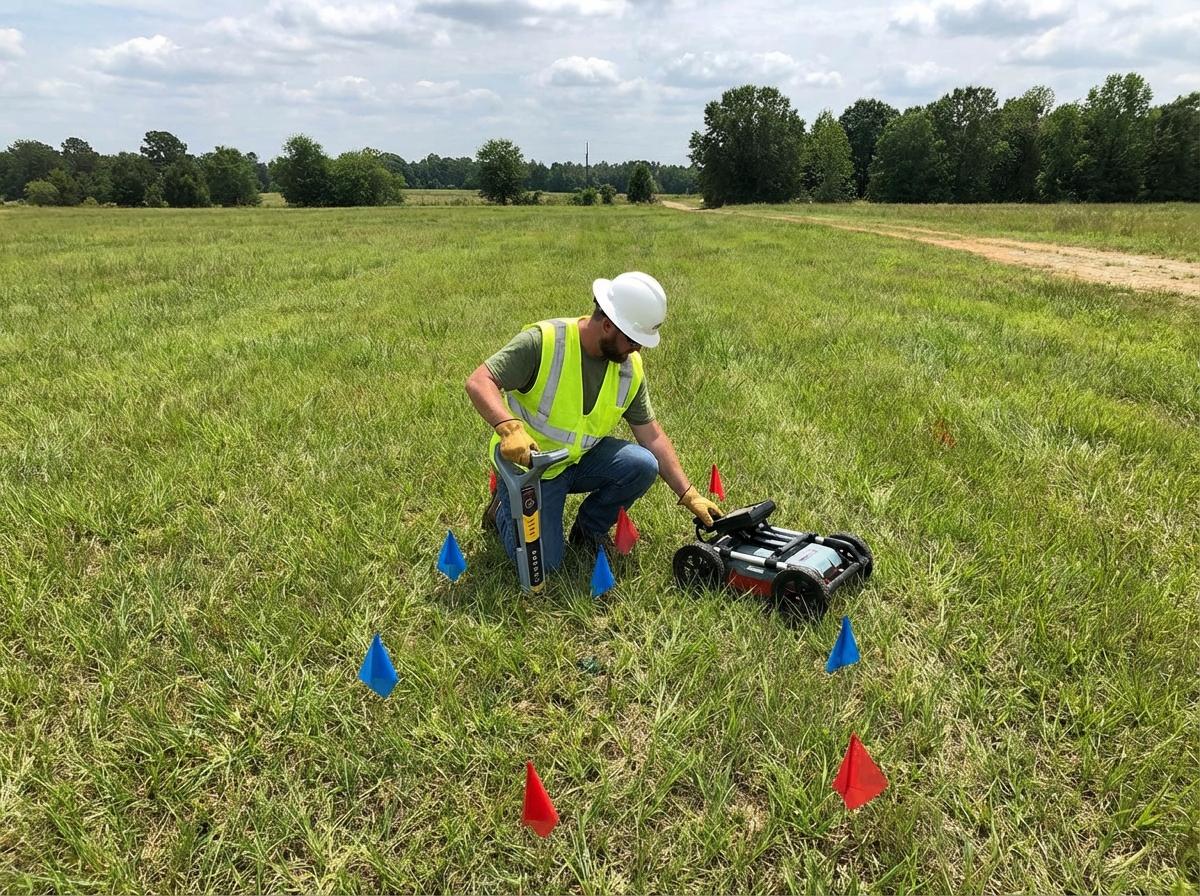
A quiet job site can hide a very loud problem
A patch of grass, a clean concrete pad, or an empty stretch of soil can look harmless. It may even look inviting. The crew arrives with a trencher, auger, or excavator, and the ground appears to be giving everyone a polite nod.
That confidence can disappear in seconds.
Below the surface may be electrical conduit, communication cable, gas piping, irrigation lines, private water service, abandoned infrastructure, or a tangled collection of all of the above. Underground utilities do not come with warning lights. They do not wave tiny flags. They simply wait beneath the work area while someone prepares to make a hole.
For field service companies, underground utility locating is not merely a technical task. It is part of production control. A missed locate can affect crew safety, project profitability, customer trust, insurance claims, and the schedule for every job that follows it.
The best operations treat locating as a gate in the workflow. A job does not move from planning to excavation until the underground picture is clear enough for the crew to work safely.
Why routine excavation deserves serious planning
Many utility strikes happen during work that feels too ordinary to deserve a formal process.
A fence contractor needs to set posts. A landscaping crew wants to install lighting. An irrigation company plans a new sprinkler zone. A paving team needs to core through a driveway. A low voltage installer is preparing a trench for cable.
None of these jobs looks like a dramatic excavation project. That is exactly why they can become dangerous. Familiar work encourages familiar shortcuts. Someone says, “We are only going down a foot,” as if buried infrastructure has signed a contract to stay deeper than that.
Small digs can still encounter shallow lines. Existing construction may have placed utilities at inconsistent depths. Landscaping, erosion, grading, repairs, and previous installations may have changed the ground profile. The crew may also be working from outdated drawings that show a tidy site nobody has seen since the building was new.
The risk is not measured by how large the hole will be. It is measured by what may be hiding inside the area being disturbed.
Public markings are only one piece of the underground picture
A public call before digging process is an important starting point, but it does not reveal every utility on a property.
Public utility owners generally mark the infrastructure they own and maintain. Private property can contain additional systems installed for a building owner, tenant, campus, or contractor. These may include:
- Electrical lines running from a main service to an outbuilding
- Communication lines serving separate offices or buildings
- Private water and sewer connections
- Gas piping beyond the utility ownership point
- Irrigation and landscape lighting systems
- Fire protection lines
- Fuel lines at industrial facilities
- Lines connecting parking equipment, gates, signs, or security systems
- Abandoned or undocumented utilities from earlier construction
A commercial property can function like a small underground city. The public locate may identify the main roads, while private locating reveals the alleys, driveways, service lanes, and suspicious tunnels behind the bakery.
The right question is not, “Did someone call before digging?” The better question is, “Have all likely utility owners and all private systems been accounted for in this work area?”
Build the locate decision into estimating
The locating process should begin before a job reaches the dispatch calendar.
Estimators, sales teams, and project coordinators are often the first people to learn that ground disturbance will occur. The estimating form should capture that fact immediately. A simple question such as “Will the proposed work disturb soil, pavement, slab, or landscaping?” can prevent a great deal of later confusion.
The estimate or site survey should also record:
- The planned excavation area
- The expected depth
- The type of equipment being used
- Whether the property is residential, commercial, industrial, or institutional
- Whether there are visible utility structures nearby
- Whether work will occur around buildings, poles, meters, or easements
- Whether the customer has drawings or previous locate records
- Whether the work is a replacement, extension, repair, or new installation
This information helps determine whether the job needs public notification, private locating, utility records, potholing, hand exposure, or a combination of methods.
It also prevents the classic scheduling surprise where a job is sold as a quick installation and later develops a hidden personality called “three days of underground investigation.”
Turn the work order into a control panel
A work order should do more than tell a technician where to go and what to install. For excavation work, it should show whether the job is actually ready.
Useful status fields may include:
- Ground disturbance required
- Public notification requested
- Public markings received
- Private locate required
- Private locate scheduled
- Private markings completed
- Site drawings attached
- Markings verified by field supervisor
- Excavation limits approved
- Customer access confirmed
- Work released for dispatch
These fields create a visible chain of responsibility. If the private locate field is blank, the job should not quietly drift into the “ready” pile because a dispatcher is juggling six phone calls and a printer that has chosen rebellion.
A color coded status system can help. Green means the job is cleared for the next stage. Yellow means information or scheduling is incomplete. Red means excavation is blocked.
The exact software matters less than the rule. The system should make an unfinished locate difficult to overlook.
Give every role a specific responsibility
Locate management becomes unreliable when everyone is vaguely responsible for it.
The estimator may identify the need. The coordinator may request the service. The locator may document markings. The dispatcher may confirm readiness. The field lead may verify the marks before digging. The project manager may approve changes to the excavation plan.
Each person should know where their responsibility begins and ends.
A practical handoff might look like this:
- The estimator flags ground disturbance during the sales process.
- The coordinator determines whether public and private locating are needed.
- The scheduling team books the locate before assigning an excavation date.
- The coordinator uploads reports, sketches, photos, and completion notes.
- The dispatcher checks the locate status before releasing the crew.
- The site lead compares the markings with the work order and planned excavation.
- The crew pauses if conditions differ from the documented plan.
This is not paperwork for the sake of paperwork. It is a relay race. When the baton is left on the track, everyone starts pointing at everyone else.
Teach crews that marks are a starting point, not a magic force field
Paint and flags are valuable, but they do not create an invisible shield around a utility.
Field crews need to understand the limits of markings, especially when using mechanical equipment. They should know the tolerance zone around identified utilities, maintain appropriate clearance, and use safer exposure methods where required by local rules and project conditions.
The crew should also inspect the site before digging. Look for meters, pedestals, valves, manholes, risers, transformers, cleanouts, light poles, and other clues that may not line up perfectly with the work order.
If markings are faded, missing, damaged, washed away, or inconsistent with visible site features, excavation should stop until the situation is reviewed. A line of orange paint that has been softened by rain is not a legally binding treasure map.
A good pre excavation briefing can cover:
- The limits of the work area
- The location and direction of marked utilities
- Areas requiring hand digging or vacuum excavation
- The equipment planned for each section
- Any uncertainty in the records or markings
- The person authorized to stop work
- The procedure for contacting the office if conditions change
This briefing can take a few minutes. A utility strike can take the rest of the week.
Protect the locate when the project changes
Many jobs begin with one plan and finish with three additions, two field adjustments, and a customer request that starts with, “While you are here.”
A trench that moves several feet may enter a completely different utility corridor. A deeper excavation may encounter infrastructure that was irrelevant to the original scope. A new connection, revised route, or expanded work area may require a fresh review and possibly a new locate.
Change management should therefore include a locating check. Before approving a field change, the project lead should ask:
- Does the revised work disturb new ground?
- Has the excavation boundary moved?
- Will the crew go deeper or wider?
- Does the new route cross marked utilities?
- Are the existing markings still visible and current?
- Does the change require another public or private locate?
This protects the crew from turning a customer request into an underground guessing game.
Keep records that explain what happened
Good documentation is useful long after the paint fades.
The work order includes store locate tickets, private locating reports, site sketches, images, field notes, customer correspondence, and approval documents. Photos should show the marked area next to buildings, driveways, poles, or walls. A close-up of orange paint floating in grass may be correct yet worthless.
Records help with several practical needs:
- Preparing future service work at the same property
- Answering customer questions
- Supporting safety reviews
- Investigating delays
- Demonstrating that required steps were followed
- Training new employees
- Comparing recurring trouble spots across properties
Over time, this information can become a private underground history for repeat customers. The first visit may involve investigation. The fifth visit should not feel like the crew has been dropped into an archaeological dig with no map.
FAQ
Is a public utility locate enough for every excavation job?
No. Public locating generally identifies utility infrastructure owned by public providers. Private systems on a property may not be included. Sites with multiple buildings, private roads, large campuses, irrigation, security systems, or internal electrical and communication networks often require additional private locating.
Should locating be requested after the job is scheduled?
It is safer to identify and schedule locating before the excavation date is finalized. Waiting until the crew is nearly ready to leave can create delays, rushed decisions, and idle labor. The locate requirement belongs in estimating, job setup, and scheduling.
What should a crew do if the markings do not match the work plan?
The crew should pause excavation and contact the designated supervisor or project coordinator. They should not assume the work plan is correct, shift the route casually, or begin digging beside questionable marks. A mismatch needs to be reviewed before the ground is disturbed.
How often should markings be checked?
Markings should be checked before work begins and throughout the project. Weather, traffic, landscaping activity, grading, and construction equipment can damage or obscure them. If markings are no longer clear, the team should follow its re-marking or verification procedure before continuing.
Who should be allowed to release a dig related job?
The release authority should be assigned to a specific role, such as a dispatcher, project coordinator, or field supervisor. The person should verify that required public and private locating steps are complete and that supporting documentation is attached to the work order.
What happens when the customer changes the installation route?
The change should be reviewed for new excavation risks before work proceeds. A shifted route, increased depth, or expanded work area may require additional locating or updated markings. Customer approval of the change does not replace the safety review.