Missing teeth can affect much more than the appearance of your smile. They can make chewing and speaking more difficult, change your bite, and influence the health of surrounding teeth and gums. Fortunately, modern dentistry offers several ways to replace missing teeth. Dentures, bridges, and dental implants each work differently, so understanding their differences can help you discuss the most appropriate solution with your dental professional.
Understanding Your Tooth Replacement Options
When teeth are lost, replacing them can help restore everyday function and improve the appearance of your smile. However, no single treatment is right for everyone. The best option depends on factors such as the number of missing teeth, the condition of your remaining teeth, your gum health, jawbone structure, lifestyle, and personal preferences.
Dentures, dental bridges, and dental implants all have distinct designs and requirements. Some are removable, while others are fixed in place. Some rely on neighboring teeth for support, while implants are designed to anchor directly into the jawbone.
Before choosing a treatment, it is important to understand how each option works and what you can expect from it.
What Are Dentures?
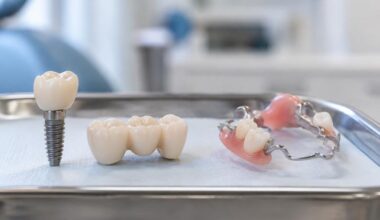
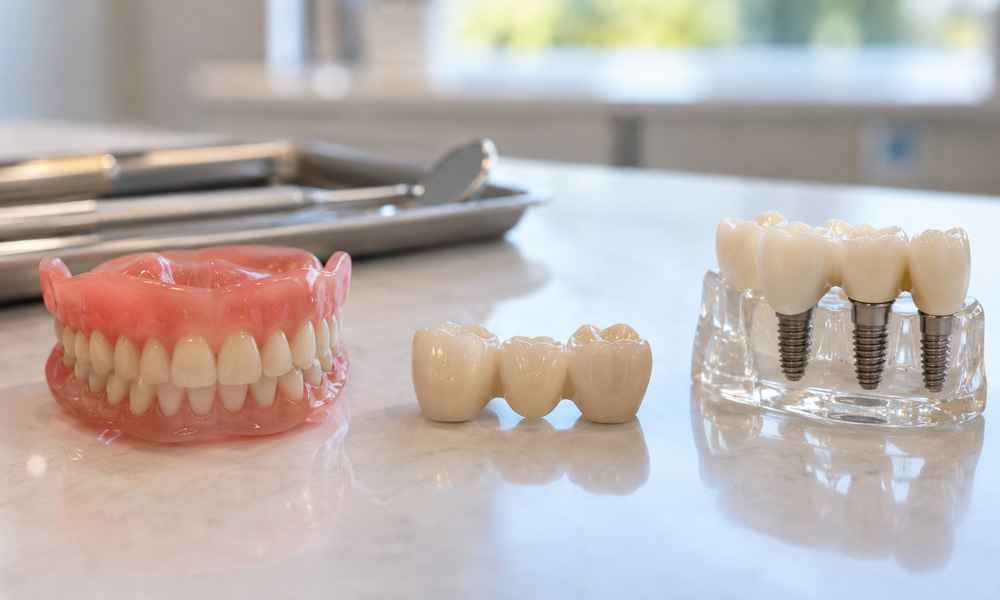
Dentures are removable dental appliances designed to replace missing teeth. Depending on how many teeth are missing, a person may receive a complete denture or a partial denture.
Complete dentures replace an entire upper or lower arch of teeth, while partial dentures replace several missing teeth while working around the natural teeth that remain. Both types are custom-designed to fit the patient’s mouth and restore basic chewing and speaking functions.
Benefits of Dentures
One of the primary benefits of dentures is their versatility. They can replace multiple missing teeth without requiring an implant for every tooth. Partial dentures can also fill several gaps at once, making them a practical option for some people with multiple missing teeth.
Dentures are removable, which makes them relatively easy to take out for cleaning. They can also be adjusted or replaced as oral health needs change. For people who are not candidates for implant treatment or who prefer a removable solution, dentures may be worth considering.
Limitations of Dentures
Because dentures rest on the gums rather than being anchored into the jawbone like natural tooth roots, they can sometimes move during eating or speaking. Proper fit is important for comfort and stability.
Dentures also require regular cleaning and maintenance. Over time, changes in the gums and jawbone can affect how they fit. A denture that becomes loose or uncomfortable may need professional adjustment or replacement.
What Are Dental Bridges?
A dental bridge is a fixed restoration designed to replace one or more missing teeth. It typically consists of artificial teeth connected to crowns or other components that are supported by neighboring teeth or dental implants.
Traditional bridges use adjacent natural teeth as anchors. The supporting teeth are prepared so that the bridge can be securely attached. Other bridge designs may use implants for support, depending on the patient’s circumstances.
Benefits of Dental Bridges
Bridges can provide a fixed solution for replacing missing teeth. Unlike removable dentures, a traditional bridge stays in place during normal activities such as eating and speaking.
They can also restore the appearance of a smile and help prevent surrounding teeth from shifting into the empty space. For someone with one or several adjacent missing teeth and healthy supporting teeth, a bridge may be an effective treatment option.
Limitations of Dental Bridges
Traditional bridges depend on neighboring teeth for support. If those teeth are weak, heavily damaged, or otherwise unsuitable, another replacement method may be more appropriate.
Because the supporting teeth may need to be reshaped, a bridge involves altering teeth that may otherwise be healthy. Bridges also require careful cleaning around and underneath the restoration to protect the supporting teeth and gums.
What Are Dental Implants?
Dental implants are designed to replace missing tooth roots as well as the visible portion of a tooth. An implant is placed into the jawbone and allowed to integrate with the surrounding bone. Once the site has healed appropriately, a restoration such as a crown can be attached.
Implants can be used to replace a single missing tooth, support a bridge, or anchor a restoration that replaces many teeth. This versatility makes them an important option in modern tooth replacement.
Benefits of Dental Implants
One of the key advantages of dental implants is their stability. Because the implant is anchored in the jawbone, it can provide a strong foundation for a replacement tooth or dental restoration.
Implants also do not require neighboring natural teeth to provide support for an individual implant crown. In addition, implant treatment can help preserve jawbone around the implant site by providing stimulation similar to that of a natural tooth root.
With appropriate care and regular dental visits, implants can provide a durable tooth replacement solution for many patients.
Limitations of Dental Implants
Dental implant treatment involves a surgical procedure and a healing period. The process can therefore take longer than receiving some other types of tooth replacement.
Not everyone is immediately eligible for implants. Adequate bone, healthy gum tissue, and suitable overall oral health are important considerations. Some patients may need additional treatment before implant placement can be considered.
Implants can also involve a greater initial investment than certain removable or traditional restorative options. A dental professional can discuss the expected treatment process, maintenance, and costs based on your specific situation.
Comparing Dentures, Bridges, and Implants
Although all three options can replace missing teeth, their differences become clearer when comparing how they are supported, maintained, and used.
Stability and Comfort
Dentures are removable and rely primarily on the shape of the gums and underlying tissues for support. Modern dentures can be designed for a comfortable fit, but some movement may occur, particularly when eating certain foods.
Traditional bridges are fixed in place and generally provide greater stability than removable dentures. Dental implants offer another level of stability because they are anchored in the jawbone and can support individual teeth or larger restorations.
Appearance and Function
All three options can be designed to improve the appearance of missing teeth. Dentures replace multiple teeth at once, while bridges can closely fill a specific gap. Implant-supported restorations can be designed to resemble natural teeth in both appearance and function.
Your dentist can help determine which approach is most appropriate based on where your teeth are missing and how the restoration needs to interact with your bite.
Maintenance
Each treatment requires ongoing care. Dentures should be removed and cleaned according to professional instructions, while bridges require careful cleaning around the supporting teeth and beneath the restoration.
Implants cannot develop tooth decay themselves, but the gums and surrounding natural teeth still require regular care. Good oral hygiene and routine dental examinations are important regardless of which tooth replacement option you choose.
Which Option Is Best for One or Multiple Missing Teeth?
The number of missing teeth is an important factor when considering treatment. A person missing one tooth may have different needs from someone missing several teeth or an entire arch.
For a single missing tooth, an implant-supported crown or dental bridge may be considered. A partial denture may also be an option depending on the surrounding teeth and the patient’s needs.
When multiple teeth are missing, treatment can involve partial dentures, bridges, multiple implants, or implant-supported restorations. The location of the missing teeth and the health of the remaining teeth can significantly influence the recommendation.
Replacing an Entire Dental Arch
When most or all teeth in an upper or lower arch are missing, replacing each tooth individually may not always be the most practical approach. Full-arch restorations can provide an alternative by using strategically positioned implants to support a complete set of replacement teeth.
For patients considering extensive tooth replacement, a full-arch implant in Columbia may be an option to discuss with a qualified dental professional. An evaluation can determine whether this approach is appropriate based on bone health, gum condition, medical history, and individual treatment goals.
Factors to Consider Before Choosing a Treatment
Selecting a tooth replacement option should involve more than comparing appearance or upfront cost. The most appropriate treatment should account for your current oral health and how the restoration will function over the long term.
Your Oral Health
Healthy gums and supporting structures are important for successful tooth replacement. Existing cavities, gum disease, damaged teeth, or bone loss may need to be addressed before certain treatments can begin.
A comprehensive dental examination can help identify these issues and determine which treatments are realistic for your situation.
Your Lifestyle and Preferences
Think about how you want your replacement teeth to fit into your daily routine. Some people prefer a removable restoration that can be taken out for cleaning, while others prefer a fixed solution that remains in place.
Your comfort expectations, dietary preferences, appearance goals, willingness to undergo a surgical procedure, and ability to maintain the restoration should all be part of the conversation.
Long-Term Care
Every tooth replacement option requires maintenance. Regular dental appointments allow your dentist to check the restoration, gums, remaining teeth, and bite.
Good brushing and interdental cleaning habits can also help protect your oral health. If you receive dentures, bridges, or implants, following the recommended care routine can contribute to better long-term results.
Making an Informed Decision With Your Dentist
Choosing between dentures, bridges, and implants is ultimately a personal decision guided by your dental needs. A professional evaluation can provide information that cannot be determined through general comparisons alone.
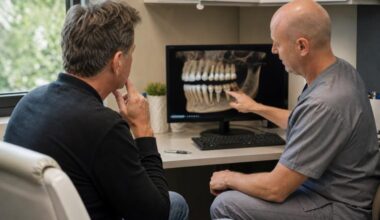
Your dentist may examine your remaining teeth and gums, assess your bite, and use dental imaging to evaluate the jawbone. If implants are being considered, the amount and quality of available bone may be particularly important.
You can also discuss treatment time, maintenance requirements, expected longevity, appearance, comfort, and cost. Asking about the advantages and limitations of each option can help you make a decision that supports both your current needs and your long-term oral health.
Conclusion
Dentures, dental bridges, and dental implants can all play valuable roles in replacing missing teeth, but they work in different ways. Dentures provide a removable solution, bridges offer fixed replacement supported by teeth or implants, and implants provide a stable foundation within the jawbone. The right choice depends on your oral health, number of missing teeth, lifestyle, and goals. A personalized dental evaluation can help you choose confidently.