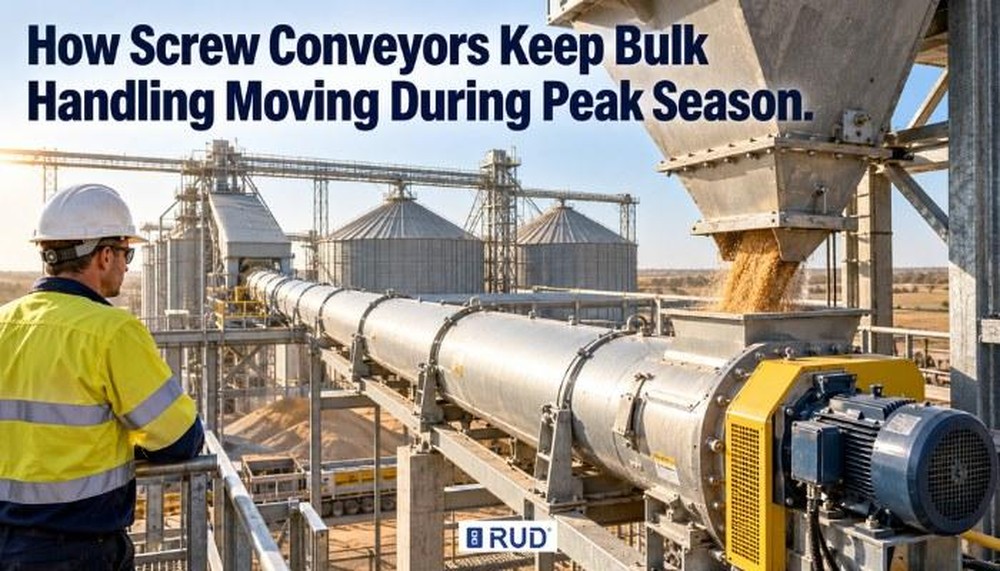
Peak season doesn’t give bulk handling operations much room for error. When volume climbs and run times stretch, the conveyor systems keep everything else on schedule by transporting materials continuously.
Screw conveyors sit at the centre of that equation for a lot of Australian industrial sites, and it’s a topic we know well here at RUD Australia. This article covers:
- How this equipment works
- Which designs hold up under sustained load
- What wear factors slow things down when production pressure builds
If you’re heading into a busy period, the information ahead is worth your time.
How Does a Screw Conveyor Move Bulk Material?
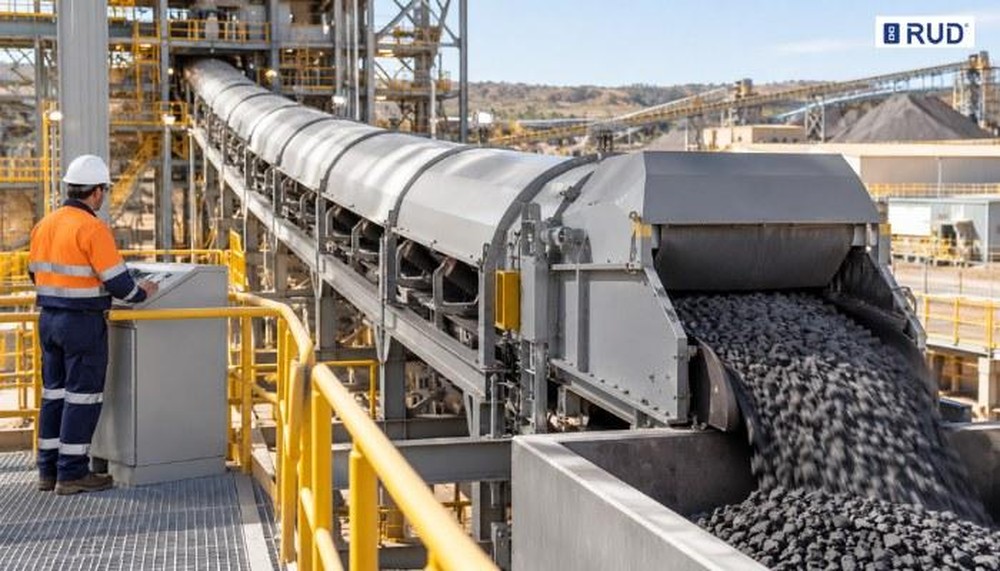
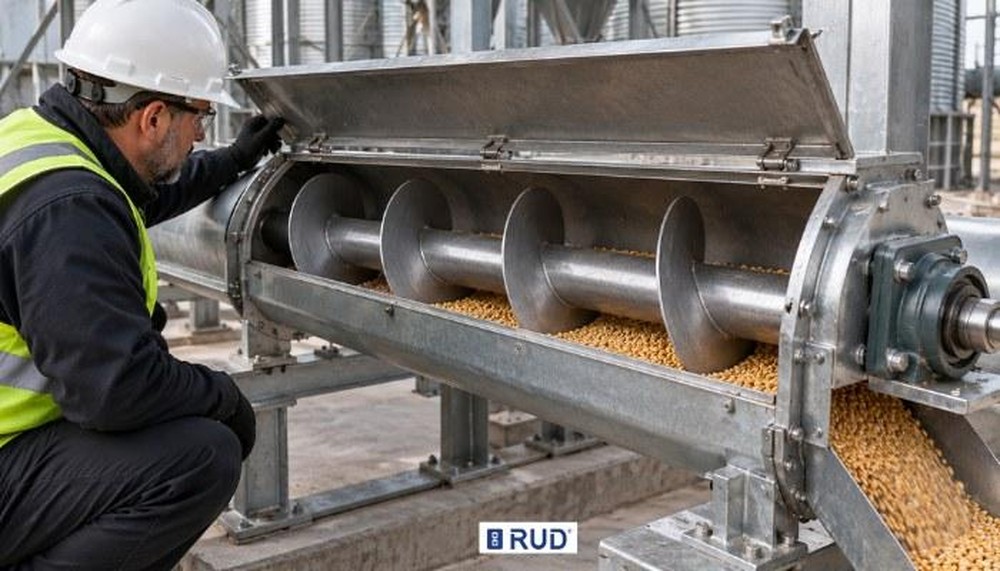
A screw conveyor moves bulk materials by rotating a helical blade inside a fixed trough or tube, pushing material from one end to the other at a controlled rate. The core components are:
- The screw flight
- Trough or housing
- Hanger bearings along its length
- Shaft seals
- A drive unit at one end
Unlike a conveyor belt, a screw conveyor is fully enclosed. This means it can transport materials in horizontal runs, on an incline, or even in vertical directions without exposing them to dust loss or moisture.
A grain handling facility, for instance, uses this type of system to convey product from receiving hoppers straight into storage silos during harvest without spillage. That reliability depends on matching the conveyor to the material and conditions it faces.
During peak season, problems often arise when a conveyor can’t handle the material or operating conditions. Belt conveyors might work well for moving dry materials over open runs. However, when it comes to controlling dust, spillage, and material flow, screw conveyors suit enclosed transfer points better.
Why Do Screw Conveyors Hold Up During High-Volume Runs?
Across fertiliser, potash, and cement processing, conveyors must handle extended periods of high-volume operation. Three structural features explain why screw conveyors hold up when volume climbs.
The Role of Trough Loading in Throughput Consistency
Screw conveyors are built around three specific trough loading levels: 15%, 30%, and 45%. Each level is measured against the material’s bulk density, abrasiveness, and flow characteristics, then applied to determine how much capacity the screw can move per revolution.
That said, a conveyor running at the wrong loading level doesn’t announce itself. It just starts losing output. During long periods of heavy use, wear can widen the gap between the screw and trough, and reduce how much material the conveyor moves.
How Enclosed Design Protects Material Flow
Open belt systems expose materials to wind loss, moisture ingress, and dust spillage, especially in outdoor plant environments. A screw conveyor, by contrast, keeps everything contained from the inlet to the discharge point.
That means it can transfer wet, fine, or moisture-sensitive materials, including grain and fertiliser, without product loss along the way. Equipment running in an open belt configuration tends to show those costs first when volume climbs.
Why Feed Rate Stays Predictable Under Load
Screw rotation speed controls feed rate directly, which gives operations teams a dependable throughput lever when production demand increases. On screw feeder applications, variable frequency drives allow real-time speed adjustments without stopping the system entirely.
So naturally, unpredictable feed rates can cause material to pile up and overload equipment further down the line. This becomes a bigger problem when several conveyors run at once during peak season.
Which Screw Conveyor Designs Work Best for High-Volume Sites?
U-trough, tubular, shaftless, inclined, and variable pitch screw conveyors are the five designs that work across high-volume bulk handling sites. The right equipment depends on the material type, site layout, and how long the system needs to run.
Choosing based on a similar setup elsewhere, without accounting for specific site conditions, is where most operations teams run into trouble. Find out where each one works best:
- U-Trough Design: This is the standard choice for horizontal bulk material handling. It’s easy to clean between runs and suits most free-flowing dry items. The design is a practical option for grain and fertiliser use across a variety of site configurations.
- Tubular Design: Fully enclosed along its entire length, this type handles incline conveying and dusty or wet materials well. However, efficiency drops above 30°, so it’s worth factoring that into any layout requiring elevation changes.
- Shaftless Design: For sticky, wet, or high-moisture materials, a central shaft creates binding issues. This design removes that problem entirely. It’s the go-to for applications where a standard screw would jam mid-run.
- Inclined Configuration: Cement and mining operations regularly use this design where elevation changes are needed within a compact footprint. It reduces the need for additional transfer conveyors between processing points in the plant.
- Variable Pitch Screw: The pitch prevents bridging and overloading at the inlet in high-volume feed situations. It widens from one end toward the outlet, which controls how materials move along the conveyor length.
For Australian bulk handling sites running through a peak period, the design choice directly affects how long the system holds throughput without intervention. It’s best to get it right before the season starts, rather than after the first unplanned stop.
Wear Factors That Slow Your Conveyor When Volume Peaks
Wear doesn’t always start with an obvious sign. In a number of cases, the performance drop is gradual, and by the time it’s noticeable, parts and equipment have already taken the damage.
The table below covers each wear point, what causes it, and the specific risk it carries during a high-volume run:
| Wear Point | Primary Cause | Peak Season Risk |
|---|---|---|
| Screw flighting | Abrasive materials, sustained high RPM | Throughput drops as flight edge thins and trough clearance grows |
| Hanger bearings | Misalignment, continuous overloading | Most maintenance-sensitive point; seizure shears coupling bolts and halts the system |
| Trough bottom | Constant material-to-surface contact | Structural wear leads to leaks and material spillage |
| Shaft seals | Fine particle ingress | Bearing contamination and premature end-bearing failure |
| Drive unit | Load exceeding rated capacity | Motor failure during peak run |
The issue is that these five points rarely fail one at a time. Say, a seized hanger bearing can shut down an entire conveyor at a cement plant during peak production. Shaft seal failure and drive unit overload often follow as compounding factors in the same event (a seized hanger bearing mid-run doesn’t wait for a convenient moment to announce itself).
To prevent bearing failure, check the conveyor and replace worn parts before peak season starts. That way, a worn gear won’t stop the entire conveyor when the plant is handling its highest volumes.
Is Your Screw Conveyor Ready Before the Rush Hits?
Screw conveyors are reliable workhorses in bulk material handling, but only when they’re set up and maintained for the demands ahead. The right design, correct trough loading, and a clear picture of your wear points are what separate a smooth peak season from an unplanned shutdown.
RUD Australia supplies screw conveyor systems for horizontal, inclined, and vertical bulk handling applications. Get in touch with our team to discuss your conveyor needs before the busy period starts.