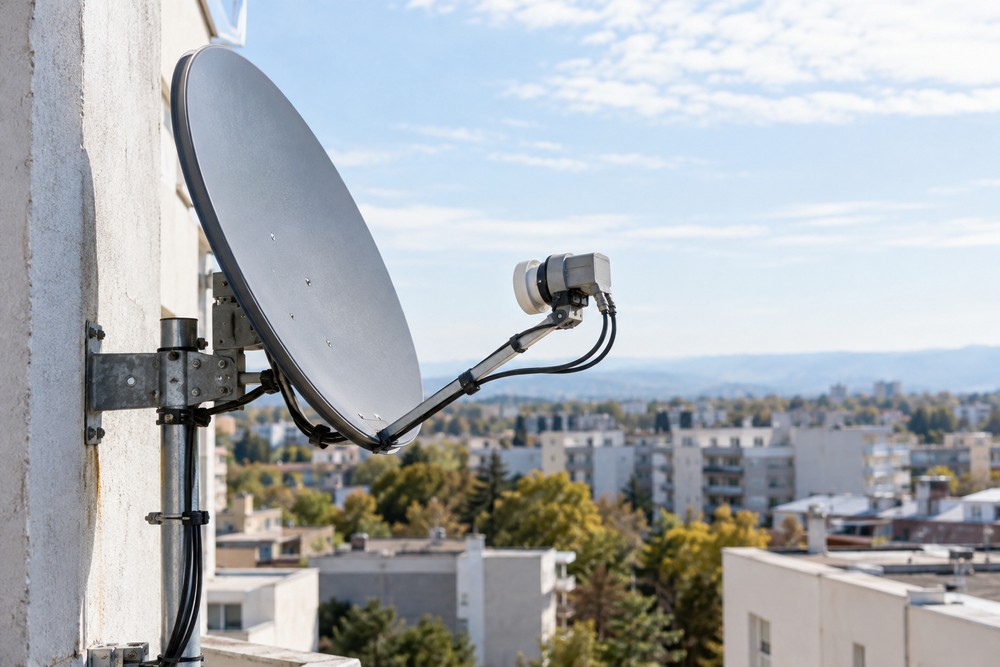
Look up at almost any building and you’ll find antennas. There are satellite dishes on apartment balconies, broadcast antennas on suburban roofs, cellular panels on office towers, and weather equipment bolted to masts at airports and research stations. Most people notice the hardware. Few think about how it actually gets the power it needs to work.
Many of these antennas need electricity at the very top, often far from the nearest outlet. Running a separate power line up every mast would be expensive, messy, and one more thing that could fail in a storm. Engineers solved this problem decades ago with a clever trick: send the power and the signal down the same cable.
Why Antennas Need Power At The Top
Radio signals weaken as they travel. By the time a broadcast, satellite transmission, or mobile signal reaches an antenna, it can be extremely faint. Pass that faint signal down a long cable to equipment inside a building, and some of it is lost along the way. Noise creeps in, and quality drops.
The usual fix is to boost the signal right at the antenna, before it starts its trip down the cable. That job falls to small amplifiers, often called preamplifiers or low-noise amplifiers. They’re designed to strengthen weak signals while adding as little extra noise as possible.
The catch is that amplifiers need electricity. And they sit exactly where electricity is least convenient, on a rooftop, at the top of a tower, or inside the housing of a dish.
One Wire, Two Very Different Jobs
Most antennas already connect to indoor equipment with a coaxial cable, the round, shielded cable familiar from cable TV and satellite setups. That cable is built to carry high-frequency radio signals with minimal loss.
It turns out the same cable can also carry steady direct current, or DC, the kind of power batteries and electronics use. Radio signals and DC power behave very differently. Radio signals oscillate rapidly, sometimes billions of times per second. DC power doesn’t oscillate at all. That difference makes it possible to send both down the same line and separate them again at each end.
The component that makes this possible is called a bias tee. It has three connections. One carries the radio signal. One carries DC power. The third connects to the shared cable, where both travel together. At the far end, another bias tee splits them apart, sending power to the amplifier and the signal onward.
Inside, the design is simple in principle. One path lets high-frequency signals through while blocking DC. The other lets DC through while blocking high-frequency signals. The result is two jobs handled by one cable, with each kept out of the other’s way.
Where You’ll Find Them
Bias tees show up in more places than most people would guess.
- Satellite and broadcast reception. Amplifiers mounted near dishes and antennas often get their power through the same cable that carries the signal indoors.
- Cellular networks. Equipment mounted high on towers frequently needs power and control signals, and sharing the coaxial line reduces the number of cables running up the structure.
- Remote control. Beyond powering amplifiers, DC can carry simple control signals to switch equipment on or off, or change settings, without a separate wire.
- Testing labs. Engineers use bias tees when testing radio components, supplying power to a device while measuring how it handles signals.
What Engineers Look For
Not every bias tee is suited to every job. A handful of factors decide which one fits.
- Frequency range is the first. Different systems operate at different frequencies, and a bias tee has to pass the full range without losing too much signal. Some designs cover several microwave bands at once, which simplifies equipment that handles more than one type of signal.
- Current and voltage handling matter just as much. Amplifiers and remote equipment draw different amounts of power, so the component has to carry enough current without overheating. For demanding setups, engineers turn to high power bias tees, built to handle more current and higher signal power without breaking down.
- Isolation describes how well the component keeps power and signal apart. Poor isolation lets one interfere with the other, which can degrade the signal or damage sensitive equipment.
- Insertion loss is the amount of signal lost simply passing through the part. Lower loss means more of the original signal survives the trip.
- Size and cost round out the list. Equipment on towers and inside compact enclosures has little room to spare, and network operators deploying thousands of sites pay close attention to price.
Durability matters too. Outdoor gear faces heat, cold, rain, and wind. Rugged construction helps components hold their performance for years without attention, which is valuable when the part sits at the top of a tall mast.
A Small Part In A Bigger Story
As demand for wireless data keeps climbing, networks are adding more antennas and pushing into higher frequencies. Higher frequencies carry more data but lose strength faster, which makes amplifiers near the antenna even more important. Every one of those amplifiers needs power, and sharing a cable remains one of the simplest ways to deliver it.
The same logic applies well beyond phones and TV. Weather stations, aviation systems, scientific instruments, and emergency communications networks all depend on antennas that have to work reliably in remote or exposed places. Fewer cables mean fewer failure points, simpler installation, and lower maintenance costs.
Questions Worth Asking About Your Own Antenna
- Does your rooftop or attic antenna use an amplifier, and how is it powered?
- Is the coaxial cable in good condition, without cracks or loose connectors?
- Are connections protected from moisture, which can corrode them over time?
- Would a shorter cable run reduce signal loss?
Most people will never see a bias tee or know it’s there. But the next time a satellite channel comes through clearly or a phone call holds steady on a windy day, part of the credit goes to a small component letting one cable do the work of two.