Core Pillars of Digital Marketing for Home Services
Effective digital marketing for home service contractors, particularly in pest control, hinges on a multi-faceted approach. It’s not just about running ads; it’s about strategically integrating various online channels to capture and convert leads. This involves a deep understanding of paid search, robust local SEO, strategic brand positioning, continuous conversion optimization, and seamless multi-channel integration, all tailored to target the right audience at the right time.
Search Engine Optimization and Local Visibility
Before diving into paid advertising, a strong foundation in Search Engine Optimization (SEO) and local visibility is crucial. For pest control businesses, this means optimizing your Google Business Profile (GBP) to appear prominently in the local map pack. This profile serves as your digital storefront, providing essential information like services, hours, and contact details. Actively managing your GBP, including consistent local citations across online directories and encouraging customer reviews, builds trust and authority. Google prioritizes businesses with recent, positive reviews, especially those that mention specific pest issues, demonstrating your expertise. Creating service area pages on your website that are optimized for organic rankings further reinforces your local presence, ensuring that when potential customers search for “pest control near me,” your business is a credible option.
Paid Search Architecture and Local Service Ads
While SEO builds long-term organic visibility, paid search offers immediate lead generation. Google Ads allows us to place your business at the top of search results for high-intent queries. Complementing this, Google Local Services Ads (LSAs) provide a “Google Guaranteed” badge, instantly building trust and often generating calls directly from the search results page. The architecture of these campaigns needs to be meticulously planned, focusing on specific search intent. This includes precise ad scheduling to ensure ads run only when your team is available to answer calls and a comprehensive list of negative keywords to prevent wasted spend on irrelevant searches. Integrating LSAs with traditional Google Search Ads creates a robust defense, ensuring continuous visibility even if one channel experiences fluctuations.
High-Performance Paid Search Strategies for Trade Contractors
Maximizing the return on investment for pest control Google Ads requires more than just a basic setup. It demands sophisticated campaign segmentation, careful selection of keyword match types, a focus on improving Quality Score, proactive bid management, and a keen eye on impression share. This ensures our ads are seen by the right people, at the right moment, without overspending.
Aligning Digital Marketing for Home Services with Urgency Types
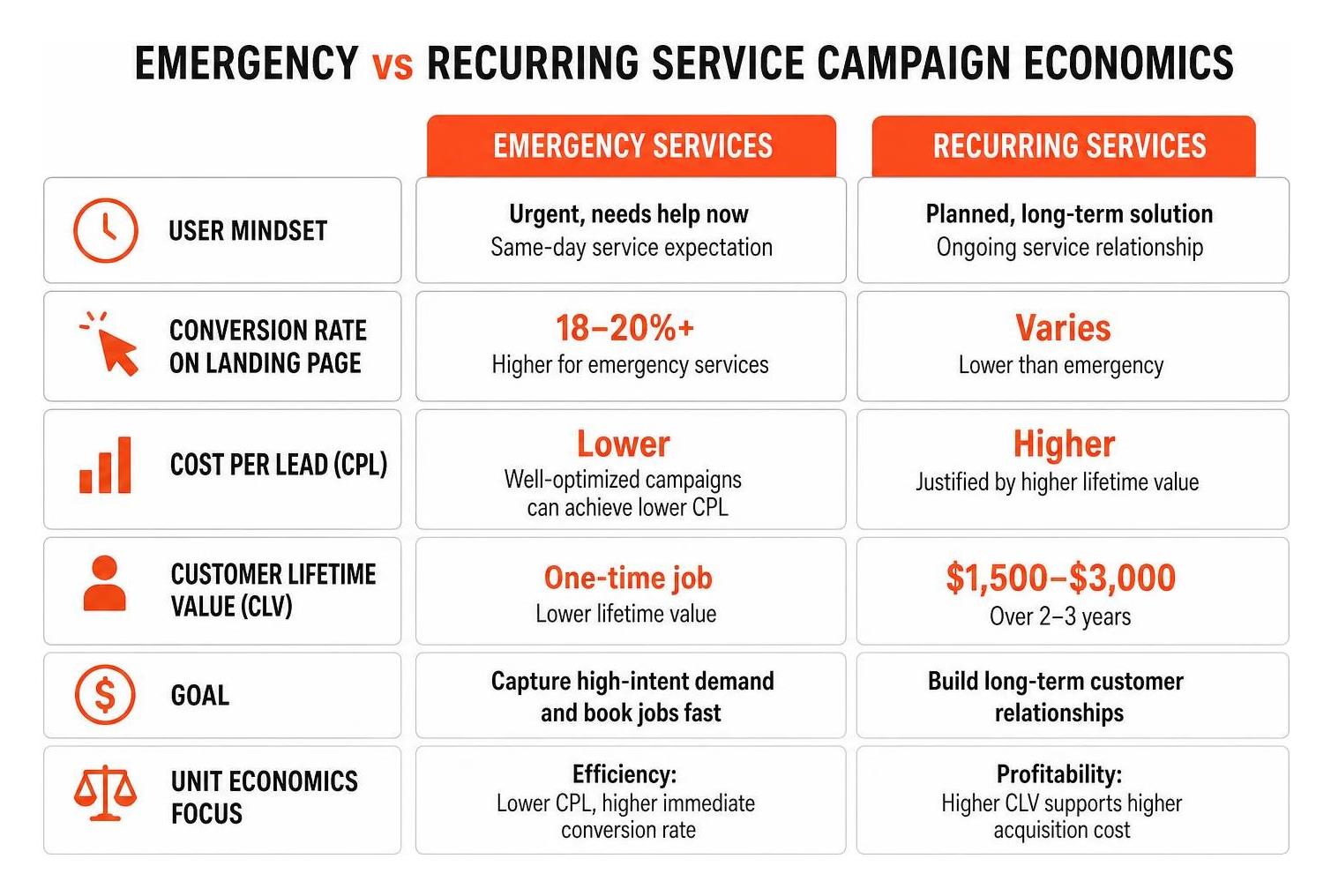
Pest control is often an emergency service. When a homeowner discovers a rodent infestation or a bed bug problem, their search intent is immediate and urgent. This “panic query” demands a different approach than a customer researching recurring maintenance plans or scheduled inspections. We categorize these customer intents to tailor our campaigns:
- Emergency Services: These campaigns target high-urgency keywords (e.g., “bed bug exterminator,” “rodent control near me”) and often utilize call-only ads or landing pages designed for immediate action. The goal is to get the phone ringing as quickly as possible.
- Recurring Maintenance/Prevention: These campaigns focus on keywords related to long-term solutions (e.g., “quarterly pest control,” “pest prevention plans”) and may direct users to landing pages that highlight the benefits of service contracts and offer detailed information.
Understanding this distinction allows us to allocate budgets and design ad copy that resonates with the searcher’s immediate need or long-term interest, optimizing for both immediate lead capture and higher customer lifetime value. For instance, high-risk specialized services like Africanized bee removal can be highlighted in ad extensions to capture niche, high-intent traffic.
Budget Allocation, Match Types, and Bidding Control
One of the most common pitfalls for pest control companies is wasted ad spend. Studies show that many businesses inadvertently squander 40% to 60% of their Google Ads budget on irrelevant keywords and audiences. To combat this, we advocate for a meticulous approach to budget allocation, keyword match types, and bidding control.
- Exact Match & Phrase Match: We primarily use exact match and phrase match keywords. This ensures our ads only appear for searches that closely align with the services offered, drastically reducing irrelevant clicks. For example, an exact match for [termite treatment] will only show for that specific query, while a phrase match for “pest control near me” will capture variations like “best pest control near me.”
- Broad Match Exclusion: We strongly advise against using broad match keywords, especially for pest control, unless meticulously managed with extensive negative keyword lists. As one industry expert humorously put it, “Google wants you to use broad match. Don’t use broad match unless you want to light your money on fire.” Broad match can trigger ads for DIY solutions, jobs, or informational searches that don’t convert into paying customers.
- Negative Keywords: A robust negative keyword list is indispensable. We continuously add terms like “DIY,” “how to,” “free,” “jobs,” “salary,” “trap,” “spray,” “repellant,” “killer,” “bait,” and “poison” to prevent ads from showing for non-commercial intent. This saves significant budget.
- Manual CPC vs. Automated Bidding: For new or low-budget campaigns (e.g., $1,000/month), starting with Manual CPC (Cost Per Click) bidding allows for precise control over spend. This strategy helps gather reliable baseline conversion data. Once a campaign consistently achieves almost one conversion per day, we can transition to automated strategies like Maximize Conversions or Target CPA (Cost Per Acquisition), providing the Google algorithm with enough data to optimize effectively. This phased approach, as demonstrated in various case studies, can reduce the cost per lead significantly.
Conversion Rate Optimization and Revenue Tracking
Generating clicks is only half the battle; converting those clicks into booked jobs is where true success lies. Conversion Rate Optimization (CRO) focuses on improving the user experience on your landing pages, ensuring clear lead capture mechanisms, prominent click-to-call buttons, and fast mobile speed. Implementing lead recovery strategies can also capture missed opportunities, further maximizing your existing ad spend. For a deeper dive into how data can transform your marketing efforts, explore resources on data-driven digital marketing.
Designing Landing Pages in Digital Marketing for Home Services
The landing page is where the conversion magic happens. Sending paid search traffic to a generic homepage is a common mistake that severely penalizes Quality Score and inflates Cost Per Click (CPC). A high-converting landing page needs specific elements:
- Clear Call-to-Action (CTA): A prominent and compelling CTA is essential. Research shows that using “Schedule an inspection today!” instead of “Schedule an estimate” can increase conversion rates by over 119%.
- Mobile Responsiveness & Speed: Most urgent pest control searches happen on mobile devices. Landing pages must load in under 3 seconds (ideally under 1.5 seconds for emergency services) and be optimized for mobile users with large click-to-call buttons above the fold.
- Trust Badges & Social Proof: Include elements like contractor licensing, insurance details, customer testimonials, and review scores to build immediate trust. Real photos of your technicians and equipment convert better than generic stock images.
- Dynamic Headlines: Using Dynamic Keyword Insertion (DKI) in headlines allows the landing page headline to dynamically match the user’s search query, increasing relevance and Quality Score.
- Service-Specific Content: Each landing page should be highly relevant to the ad and keyword. If someone searches for “termite treatment,” they should land on a page specifically about termite treatment, not a general pest control page.
Attribution, Call Tracking, and Unit Economics
Accurate tracking and attribution are paramount to understanding your campaign’s true performance. For pest control, where over 60% of leads originate from phone calls, robust call tracking is non-negotiable. This involves setting up call extensions in your ads and using dedicated tracking numbers to attribute calls to specific keywords and campaigns.
We continuously track:
- Cost Per Lead (CPL): In 2025, the average pest control lead cost on Google was around $98. However, well-optimized campaigns can achieve CPLs significantly lower, such as the $43.05 seen in a case study with a $1,000/month budget.
- Conversion Rate (CVR): The average click-through rate (CTR) for pest control is 5.5%, but conversion rates on optimized landing pages can reach 18-20% or even higher for emergency services.
- Customer Lifetime Value (CLV): For recurring pest control services, the CLV can be substantial, often ranging from $1,500 to $3,000 over 2-3 years. This allows us to justify a higher initial acquisition cost for these valuable customers.
- Return on Ad Spend (ROAS): Google estimates that, on average, companies make $2 for every $1 they spend on Google Ads. Our goal is always to exceed this benchmark.
By meticulously tracking these metrics, we gain a clear picture of our unit economics and can make data-driven decisions to optimize campaigns for maximum profitability.
Frequently Asked Questions About Home Service Marketing
Navigating the complexities of Google Ads for pest control often brings up common questions. Here, we address some of the most pressing concerns for home service contractors.
How can independent contractors compete against large national franchises?
Competing with national chains like Terminix and Orkin, which boast six-figure ad budgets, might seem daunting. However, independent contractors have several advantages:
- Hyperlocal Targeting: We focus on tight geographic radius targeting (e.g., 10-20 miles around your service area), preventing wasted spend outside your operational zone. National chains often have broader, less efficient targeting.
- Long-Tail Keywords: Instead of battling for highly competitive, broad terms, we target informational long-tail keywords (e.g., “how to get rid of termites in attic”) or specific service-location combinations (e.g., “ant control Your City”). These often have lower CPCs and higher conversion intent.
- Aggressive Negative Keyword Lists: A comprehensive negative keyword strategy (often including thousands of terms) helps local businesses avoid showing up for irrelevant searches, a common pitfall for less-managed national campaigns.
- Localized Reviews & Credibility: Local businesses can cultivate authentic customer reviews that mention specific pest issues and locations, building credibility that generic national branding often lacks. Google prioritizes this local relevance.
- Agile Bidding & Optimization: Smaller businesses can be more agile in adjusting bids and ad copy in response to seasonal pest outbreaks or local events, something larger, more bureaucratic organizations struggle with.
What is a realistic cost per lead across home service Google Ads campaigns?
A realistic cost per lead (CPL) for pest control Google Ads can vary significantly based on location, competition, and the specific pest service. While the average pest control lead cost on Google in 2025 was around $98, this is a broad average.
- Service Categories: CPLs can range from as low as $30 for mosquito control in certain seasons to $45 for rodent control, but can also exceed $200 for unoptimized broad campaigns. Highly competitive keywords, especially for urgent services like bed bugs or termites, can have CPCs of $30 or more.
- Optimization Impact: Through aggressive optimization, including precise keyword targeting, negative keywords, and high-converting landing pages, we have seen CPLs drop to around $43.05 for clients on a $1,000/month budget.
- Ticket Values & Close Rates: It’s crucial to consider the average ticket value and your close rate. A higher CPL might be acceptable for a high-value service like termite fumigation, which has a significant profit margin, compared to a lower-margin general pest control service.
We aim to achieve a CPL that allows for a profitable return after factoring in your service costs and close rates, always striving for efficiency.
When should campaigns transition from manual bidding to automated Smart Bidding?
The transition from manual bidding to automated Smart Bidding is a critical strategic decision. We generally recommend starting with Manual CPC for new campaigns or those with limited budgets. This allows us to:
- Gather Data Baseline: Manual bidding provides direct control and helps us accumulate initial conversion data without the algorithm making potentially costly assumptions. This is especially important when you don’t have historical data.
- Control Costs: For accounts with budgets under $5,000/month, manual bidding prevents automated systems from overspending due to insufficient conversion signals.
The optimal time to transition to automated strategies like “Maximize Conversions” or “Target CPA” is when the campaign has accumulated enough reliable conversion data. A good rule of thumb is when the account is consistently generating almost one conversion per day. At this point, Google’s algorithms have enough signal to learn and optimize effectively, often leading to improved performance and efficiency. Attempting to use Smart Bidding too early can lead to volatile performance and wasted budget as the system struggles to find patterns without sufficient conversion history.
Conclusion
Mastering Google Ads for your pest control business in September 2026 is not just about spending money; it’s about strategic, data-driven execution. By focusing on hyperlocal targeting, meticulous keyword management, high-converting landing pages, and robust conversion tracking, small and medium-sized contractors can effectively compete with national chains. We believe in continuous optimization, a predictable lead flow, and sustainable growth, all underpinned by transparent revenue tracking. By implementing these strategies, you can transform your Google Ads campaigns into a powerful engine for acquiring new clients and ensuring your business thrives.