What is a Medical Billing Specialist: Role vs. Medical Coding
Many people entering the healthcare industry often confuse medical billing with medical coding. While these two functions are inextricably linked, they represent distinct steps in the revenue cycle.
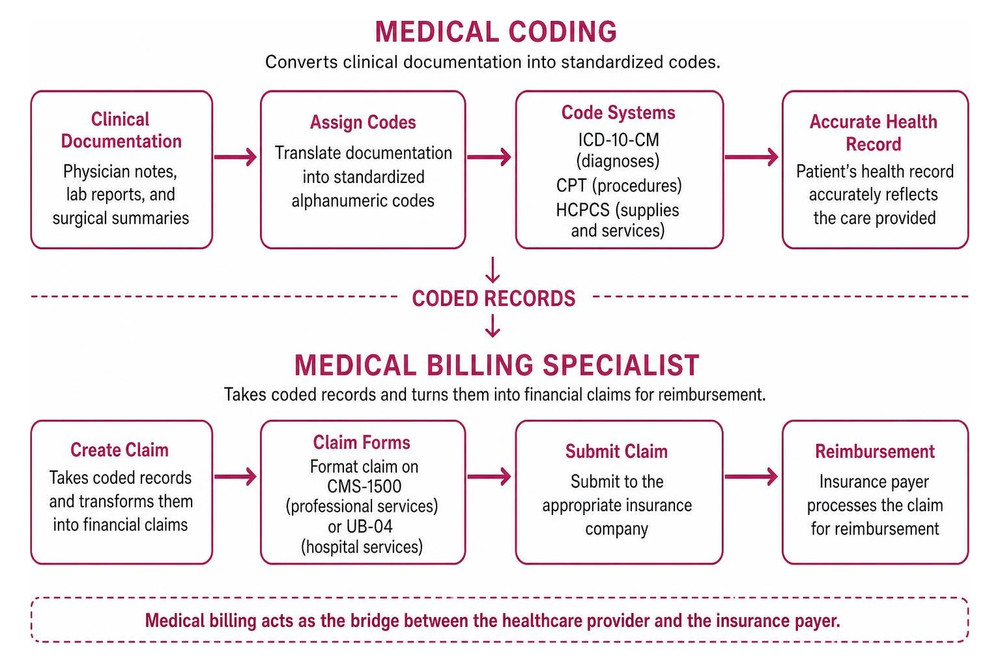
Medical coding is the process of translating clinical documentation—such as physician notes, lab reports, and surgical summaries—into standardized alphanumeric codes. Professionals in this role use systems like ICD-10-CM (for diagnoses), CPT (for procedures), and HCPCS (for supplies and services) to ensure that the patient’s health record accurately reflects the care provided.
The Medical Billing Specialist, by contrast, takes those coded records and transforms them into financial claims. They act as the bridge between the healthcare provider and the insurance payer. A biller ensures that the claim is formatted correctly on forms like the CMS-1500 (for professional services) or the UB-04 (for hospital services) and submitted to the appropriate insurance company for reimbursement.
Core Responsibilities in the Revenue Cycle
The daily workflow of a billing specialist is centered on the revenue cycle, a multi-stage process that ensures a practice remains financially viable.
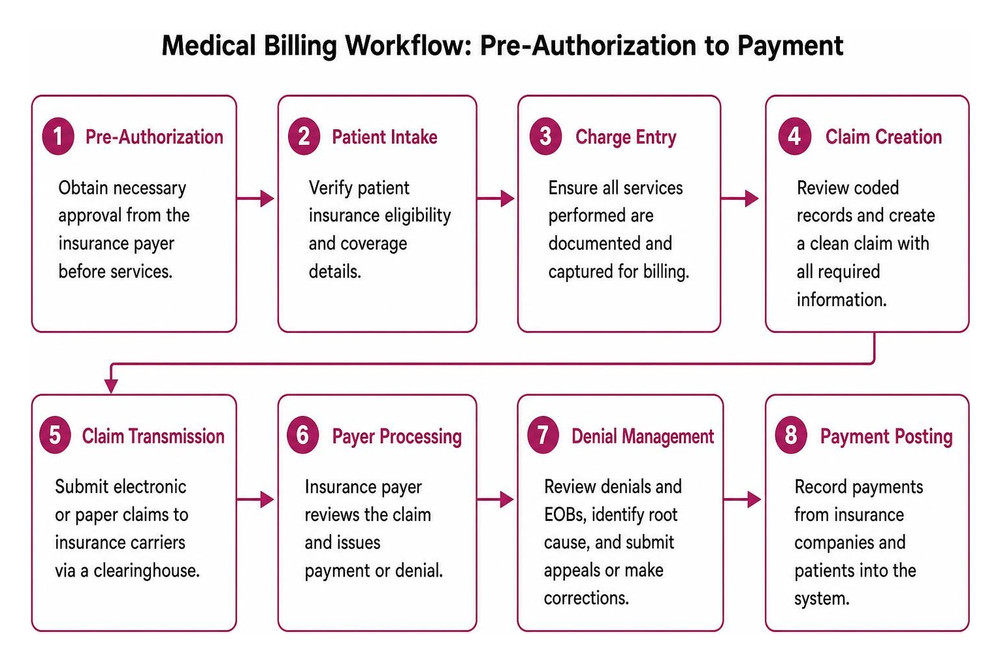
- Patient Intake: Verifying patient insurance eligibility and coverage details before services are rendered.
- Charge Entry: Ensuring that all services performed are documented and captured for billing purposes.
- Claim Transmission: Submitting electronic or paper claims to insurance carriers.
- Payment Posting: Recording payments received from both insurance companies and patients into the practice management system.
Essential Technical and Interpersonal Skills
Success in this field requires more than just an understanding of insurance forms. A top-tier specialist must be proficient in HIPAA compliance to protect sensitive patient health information (PHI). They also need strong analytical reasoning to troubleshoot rejected claims and the interpersonal skills to communicate clearly with patients regarding their financial responsibilities. Proficiency in Electronic Health Record (EHR) software is also a non-negotiable requirement in today’s digital-first clinical environment.
Step-by-Step Breakdown of the Medical Billing Process
The billing process is a systematic journey that begins long before a claim is ever sent.
Claim Creation and Submission
Once a patient visit is complete, the billing specialist reviews the documentation to ensure that the codes provided by the coder are supported by the clinical notes. They then generate a “clean claim”—a claim that is free of errors and contains all necessary demographic and clinical information. This claim is sent through a clearinghouse, which acts as a middleman to check for errors before forwarding the data to the insurance payer.
Denial Management and Payment Reconciliation
Not every claim is paid on the first attempt. When a claim is denied or rejected, the billing specialist must perform a root-cause analysis. This involves reviewing Explanation of Benefits (EOB) documents and using Claim Adjustment Reason Codes (CARCs) to identify why the payer withheld payment. Whether the issue is a simple clerical error or a complex medical necessity dispute, the specialist must file appeals or correct the data to secure the revenue the practice has earned.
Education, Training, and Industry Certifications
While some individuals enter the field with on-the-job training, most employers today prefer candidates with formal education. Vocational programs, community college certificates, or associate degrees in Health Information Management provide the foundational knowledge required, including medical terminology, anatomy, and federal insurance guidelines.
Top Credentials for Career Advancement
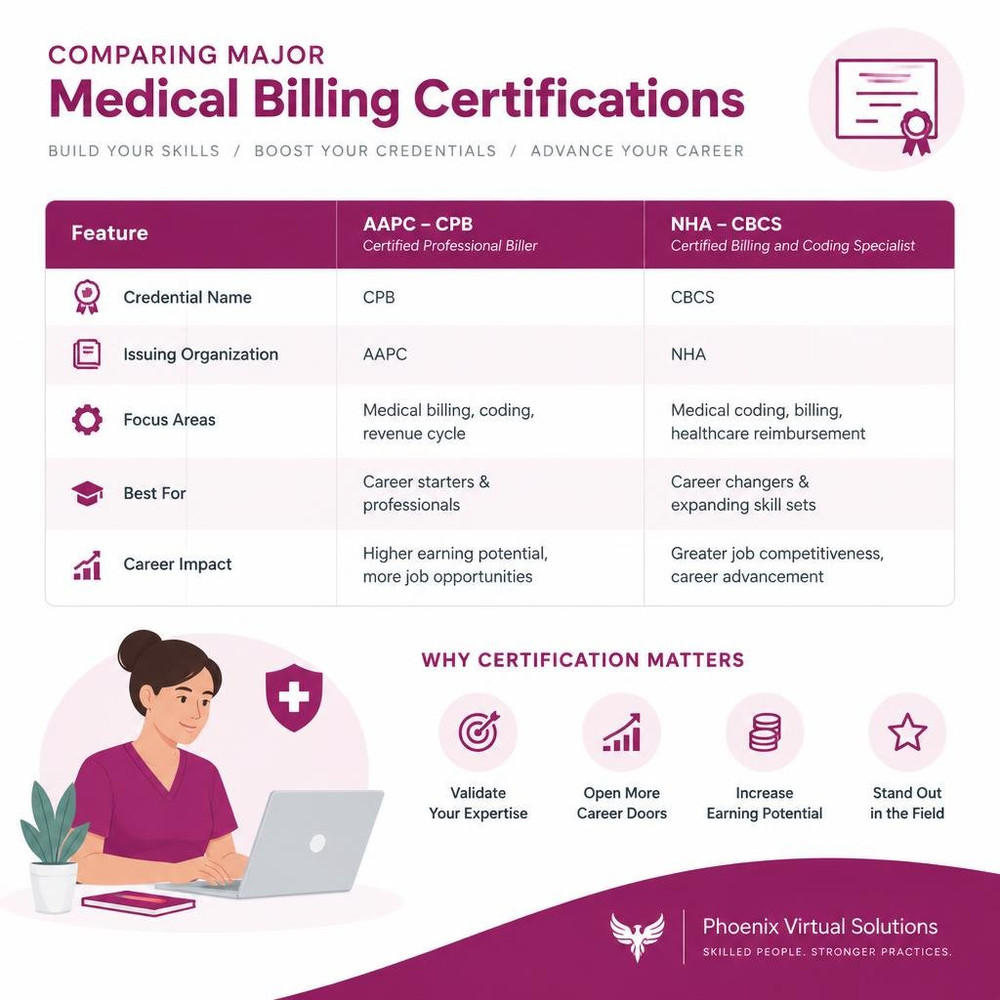
Professional certification is the fastest way to signal your expertise to potential employers. Organizations such as the AAPC (offering the CPB credential) and the NHA (offering the CBCS credential) provide rigorous testing that covers the breadth of the revenue cycle. Holding these certifications often results in higher salary brackets and faster career progression.
Mastering EHR Systems and Modern Billing Technology
Modern medical billing is heavily reliant on technology. Specialists must be comfortable navigating cloud-based EHR and Practice Management (PM) systems. These platforms often include automated “scrubbers” that catch common errors before submission. Understanding how to pull reports and analyze billing analytics is also critical, as it allows the specialist to identify trends in claim denials and suggest process improvements to the practice manager.
The Market for Hiring Medical Billing Specialists: Salaries and Outlook
The healthcare industry is experiencing rapid expansion, and the administrative side is no exception. As medical practices consolidate and the population ages, the demand for professionals who can manage complex insurance landscapes continues to rise. For those interested in hiring medical billing specialists, the focus is increasingly on finding talent that can demonstrate a high “clean-claim rate”—the percentage of claims paid on the first submission.
Regional Demand and Trends in Hiring Medical Billing Specialists
In major Canadian hubs like Toronto and Vancouver, the demand for billing talent is driven by a mix of private clinics and public health system reporting. Meanwhile, in the U.S., major metropolitan areas see high demand for specialists who can handle complex Medicare and Medicaid regulations. Remote work has become a significant trend, allowing specialists to work for practices in different states or provinces, which often leads to more competitive salary packages for those with specialized experience.
Key Criteria Healthcare Providers Look for When Hiring Medical Billing Specialists
Employers are looking for more than just data entry clerks. They want “revenue cycle partners.” When vetting candidates, they prioritize:
- AR Compression: The ability to reduce the number of days accounts receivable (AR) remain unpaid.
- Audit Readiness: A deep understanding of compliance to ensure the practice is protected during external audits.
- Denial Salvage: A proven track record of successfully overturning denied claims.
Career Pathways, Specializations, and Remote Opportunities
The career path for a billing specialist is not a dead end; it is a ladder. Many begin as billing clerks or assistants and move into specialized roles such as Denial Management Specialists, Revenue Cycle Auditors, or even Practice Managers.

Navigating Complex Payer Mixes and Denial Overturns
Specialization is a powerful way to increase your value. Specialists who focus on niche areas—such as workers’ compensation, behavioral health, or complex surgical billing—are often paid a premium. These roles require a deep understanding of specific payer rules and the ability to craft compelling appeal letters that get results.
Long-Term Career Growth in Revenue Cycle Management
For those with leadership aspirations, the path leads to roles like Revenue Cycle Manager or Billing Supervisor. In these positions, you are responsible for the financial health of an entire organization, managing teams of billers and coders, and implementing new technologies to improve efficiency.
Frequently Asked Questions About Medical Billing Careers
What is the difference between a medical biller and a medical coder?
A coder translates medical notes into standard codes. A biller takes those codes and uses them to submit claims to insurance companies and collect payments.
How long does it take to become a certified medical billing specialist?
Depending on the program, you can complete a certificate in as little as six months. Self-paced study for certification exams can take another three to six months of dedicated preparation.
Can medical billing specialists work remotely?
Yes. Because most billing is done through secure, cloud-based EHR software, many specialists now work from home using encrypted VPNs to maintain HIPAA compliance.
Conclusion
The role of the Medical Billing Specialist is the financial heartbeat of any healthcare facility. By mastering the nuances of the revenue cycle, staying updated on coding regulations, and leveraging professional certifications, you can build a stable, high-growth career that provides essential support to both providers and patients. Whether you are just starting your journey or looking to take the next step in your professional development, the opportunities in this field are as vast as they are rewarding.