Key Takeaways
- Get out of danger and seek medical help before worrying about photographs or insurance paperwork.
- Call law enforcement when required, and ask how to obtain the crash report number.
- Keep photographs, damaged riding gear, medical records, receipts, and witness information.
- Do not guess about speed, fault, or the full extent of your injuries.
- Read insurance documents carefully before accepting a settlement or signing a release.
A motorcycle crash can leave you shaken, hurt, and unsure what to do next. Whether the collision happens near a busy Decatur intersection, on I-285, or along a neighborhood street in Metro Atlanta, your first priorities should be safety and medical care. After immediate needs are addressed, speaking with a Motorcycle Accident Attorney Atlanta riders can turn to may help you understand the practical and legal issues that can follow.
The steps you take in the first hours and days can protect your health while helping preserve information about what occurred. You do not need to determine fault at the scene. Instead, focus on getting help, documenting what you can safely document, and keeping records as your recovery develops.
Why the First Steps Matter
Adrenaline can mask pain and make it difficult to remember details after a collision. A simple order of action can help: get safe, call for assistance, obtain medical care, report the crash, and preserve evidence. Motorcycle collisions can cause serious injuries even when a bike appears to have limited damage. In 2024, 6,228 motorcyclists were killed in U.S. traffic crashes, according to national motorcycle safety data.
Get Safe and Check for Injuries
Move away from active traffic only if you can do so safely. Stay clear of leaking fuel, smoke, fire, unstable vehicles, and downed power lines. If someone is seriously injured, avoid moving them unless there is an immediate danger, because movement may worsen a possible neck or spinal injury.
Know When Emergency Care Is Needed
Call 911 for heavy bleeding, breathing trouble, loss of consciousness, confusion, repeated vomiting, severe headache, numbness, weakness, or significant neck or back pain. A concussion, internal injury, or soft-tissue injury may not be obvious immediately. A helmet and protective clothing can reduce risk, but they do not eliminate the need for medical evaluation after a hard impact.
Report the Crash
Georgia law (O.C.G.A. § 40-9-3) generally requires a driver involved in a crash causing injury, death, or apparent property damage of $500 or more to immediately notify the appropriate law enforcement agency. A police report can identify the location, the involved vehicles, the road conditions, the witnesses, and the responding officers.
Keep Your Statement Factual
- Describe what you personally saw, heard, or felt.
- Avoid estimating speed, distance, or fault if you are unsure.
- Do not dismiss pain simply because it seems manageable at the moment.
- Ask for the report number and instructions for obtaining a copy.
Document the Scene
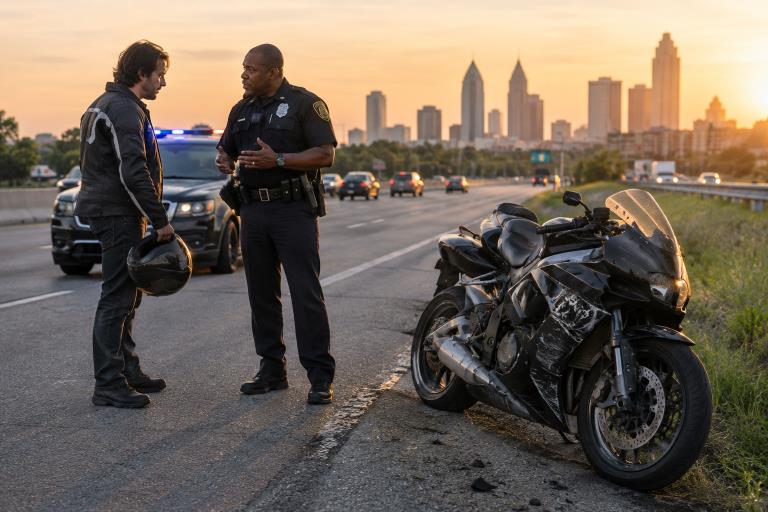
If it is safe, use your phone to photograph the scene before vehicles are moved. Capture the motorcycle, every involved vehicle, license plates, lane markings, traffic lights, signs, debris, skid marks, potholes, loose gravel, and the broader roadway layout. In Metro Atlanta, nearby construction, complex intersections, changing lanes, and heavy traffic can all be important context.
Get names and contact information for witnesses. Also note nearby businesses, homes, traffic cameras, or doorbell cameras that may have recorded the collision. Video footage can be overwritten quickly, so identifying potential sources early may be important.
Preserve Your Motorcycle and Gear
Your motorcycle’s condition can help show the location and force of an impact. Photograph it before repairs, cleaning, disassembly, or salvage whenever possible. Keep the damaged helmet, jacket, gloves, boots, protective armor, broken parts, towing records, storage receipts, and repair estimates.
Save original photos, video files, text messages, and emails in more than one location. Do not throw away damaged gear because it looks unusable. It may later help document the severity and mechanics of the crash.
Seek Medical Care and Track Recovery
See a medical professional promptly if you experience pain or new symptoms after the crash. Follow treatment instructions and attend recommended follow-up appointments. Keep copies of emergency room records, doctor’s notes, prescriptions, therapy records, medical bills, travel costs, and documents showing missed work or reduced duties.
A short-dated recovery journal can also be useful. Note how pain, limited movement, headaches, sleep problems, or emotional symptoms affect ordinary activities, including work, driving, exercise, and caring for family members.
Handle Insurance Contact Carefully
Report the collision to your insurer as your policy requires, but keep early communications accurate and limited to known facts. Record the claim number, adjuster’s name, phone calls, emails, and every document you send or receive. Coverage may involve liability insurance, medical payments coverage, uninsured motorist coverage, or underinsured motorist coverage.
Pause Before Signing
Read repair authorizations, settlement offers, and releases carefully. A release may end your ability to pursue additional payment later. If treatment is ongoing or you do not yet know how the injury will affect your ability to work, avoid making final statements about your recovery.
Avoid Common Mistakes
- Leaving required information before it is exchanged, or law enforcement arrives.
- Assuming delayed pain is unimportant.
- Posting opinions, photos, or recovery updates about the crash on social media.
- Discarding a damaged helmet or other riding gear.
- Missing medical appointments without documenting the reason.
- Accepting quick payment before understanding whether it resolves all claims.
Understand Georgia Rules and Deadlines
Georgia requires motorcycle operators and passengers to wear protective headgear that meets applicable standards (O.C.G.A. § 40-6-315), with limited statutory exceptions. The state also uses a modified comparative-fault rule (O.C.G.A. § 51-12-33). If you are found partly responsible, any recovery may be reduced by your percentage of fault, and recovery is barred if you are 50 percent or more responsible.
Deadlines can be just as important. In many Georgia injury cases, the deadline to file suit is two years from the date the claim accrues (O.C.G.A. § 9-3-33), while a claim for property damage may have a different deadline. Individual circumstances can affect those time limits, so do not wait until the last moment to investigate your options. Riders can also review Georgia-specific training and licensing guidance through the Motorcycle Operators Manual.
Moving Forward After a Crash
After a motorcycle accident in Decatur or Metro Atlanta, focus first on safety, treatment, and reliable records. Careful documentation can make it easier to explain what happened, track your recovery, and make informed decisions about insurance and any next steps.