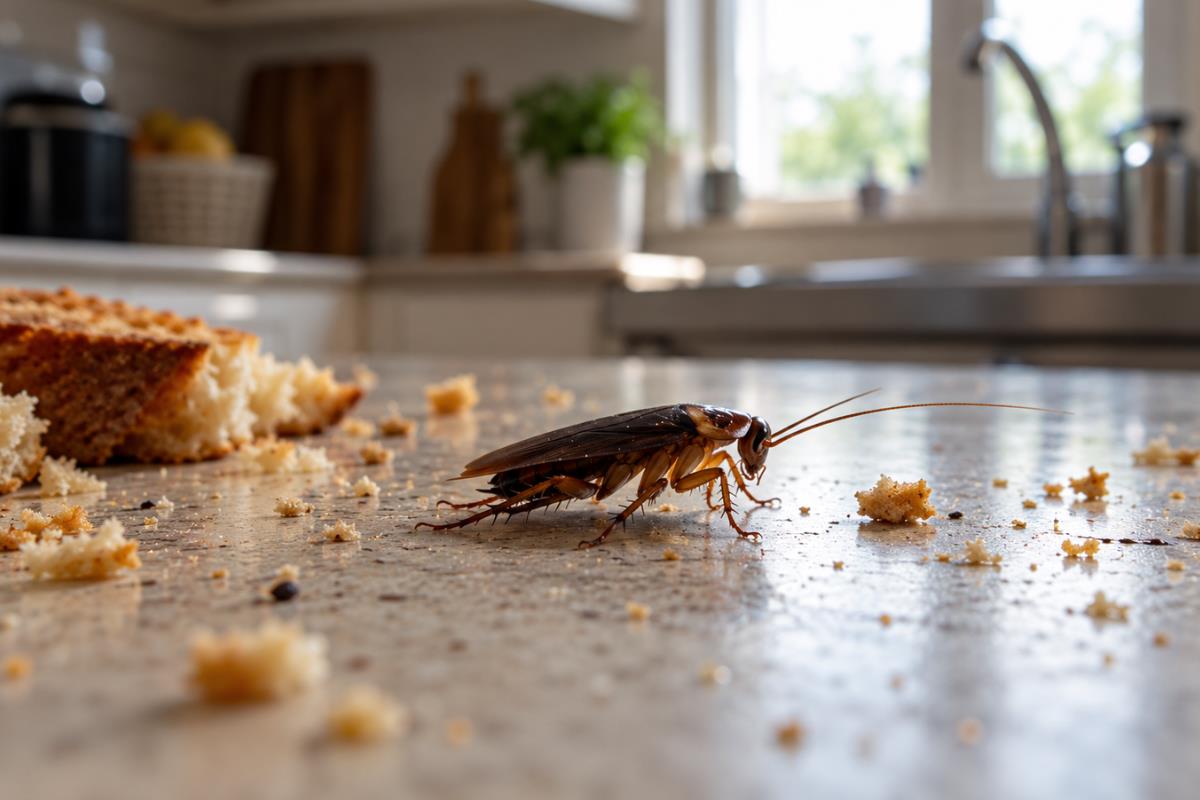
Cockroaches are one of the most common and persistent pest problems found in both private homes and commercial spaces, including restaurants, bakeries, food stores, medical facilities and offices. They reproduce quickly, hide in difficult-to-reach areas and can remain unnoticed until the infestation becomes more serious.
Getting rid of cockroaches is not simply a matter of choosing an insecticide and spraying it around the room. The type of product, the application method and the areas being treated all have a direct impact on the results. Using the wrong approach can waste both time and product without addressing the source of the infestation.
What types of cockroach insecticide are available?
There are two main types of insecticide commonly used for cockroach control: contact insecticides, usually applied by spraying, and insecticide gels, which work as bait and attract cockroaches to feed on them. Each method has its own role, and in some situations they can be used together as part of a more comprehensive treatment.
Glue traps are another useful tool, but their main purpose is monitoring and detection rather than eliminating an established infestation. They can help identify where cockroaches are active and provide information about the severity of the problem.
Contact insecticides: How to spray correctly
How they work and why application matters
A contact cockroach insecticide is designed to affect cockroaches when they come into contact with treated surfaces. When properly applied, the active ingredient is deposited on areas where cockroaches are likely to move and can remain active for a certain period, depending on the formulation and environmental conditions.
However, the effectiveness of a spray treatment does not depend only on the product itself. Application technique is just as important.
A common mistake is to spray large areas randomly, covering floors or walls without considering cockroach behaviour. This can result in unnecessary product consumption while leaving the areas where cockroaches actually hide and travel untreated.
Where should contact insecticides be applied?
Cockroaches do not move randomly around a room. They tend to follow edges, corners and sheltered areas, particularly near sources of food, water and warmth.
For this reason, treatment should focus on areas where cockroaches are most likely to travel. Depending on the product label and the conditions of the site, these may include:
- Along floor and wall junctions
- Around corners and edges
- Around door and window frames
- Behind and underneath furniture
- Around kitchen appliances
- Behind refrigerators and cooking equipment
- Around cabinets and other hiding places
- Near waste storage areas
In a kitchen, for example, treating the area around and underneath appliances can be particularly important. Refrigerators, ovens, sinks and cabinets can create warm, dark and protected spaces where cockroaches remain hidden during the day.
If cabinets are heavily infested and can be emptied, treatment may also be possible inside them, provided that the product label allows it. Any food-contact surfaces must be cleaned thoroughly after treatment, and insecticide should never be applied directly to food, dishes or other surfaces where contamination could occur.
Waste storage areas also deserve particular attention. Whether the waste is kept in a simple bin or in a dedicated cabinet, the surrounding area can provide food, moisture and shelter for cockroaches.
What about heavy infestations?
More extensive treatment may be necessary in areas with a high level of infestation, particularly in damp environments, basements, service areas or spaces with exposed plumbing and drainage systems.
In these situations, the treatment should be based on a careful inspection of the entire area rather than simply increasing the amount of insecticide used. Areas showing signs of cockroach activity should receive particular attention, always according to the product label and applicable safety requirements.
The more favourable the environment is for cockroach survival, the more important it becomes to identify and address the conditions that allow the infestation to persist.
Insecticide gels: Baiting cockroaches where spraying cannot reach
What are cockroach gels and how do they work?
Insecticide gels work differently from conventional contact sprays. They are formulated as ready-to-use baits containing attractants that encourage cockroaches to feed on the gel.
One of their main advantages is that they can be placed in small amounts in areas where spraying may be difficult or unsuitable. They also do not require the same type of surface coverage as a conventional spray treatment.
After feeding on the bait, a cockroach may return to its hiding spot before dying. Other cockroaches can then come into contact with or feed on contaminated material, depending on the formulation and the behaviour of the species. This can contribute to a secondary or cascading effect within the population.
The result is particularly useful when part of the infestation is hidden inside cracks, behind equipment or in other inaccessible areas.
When should gel be used instead of spraying?
Gel bait is particularly useful when cockroaches are hiding in locations that are difficult to treat with a spray. These can include spaces behind refrigerators and ovens, gaps around pipes, cracks and crevices, cabinet interiors and areas where direct spraying is impractical.
Another important consideration is insecticide resistance. Cockroach populations can develop resistance to certain active ingredients or insecticide classes, particularly when the same products are repeatedly used over time. When reduced susceptibility is suspected, relying on the same active ingredient or mode of action may not provide satisfactory control.
In such cases, you may need to consider alternative active ingredients or modes of action, together with other control measures. Gel bait can form part of this strategy, depending on the product and the specific infestation.
Where and how should cockroach gel be applied?
Gel should generally be placed in small spots in areas where cockroaches are active or are likely to travel. Typical locations may include:
- Inside cabinets and cupboards
- Behind refrigerators and ovens
- Under kitchen equipment
- Around pipes and service openings
- Near cracks and crevices
- Around areas where cockroach activity has been observed
- In sheltered locations close to food and water sources
The exact placement and quantity should always follow the product label.
One practical advantage of gel bait is that it can often be applied without completely emptying or closing the premises. This can make it suitable for environments such as offices, shops, restaurants and other commercial spaces where extensive disruption is undesirable.
However, gel should not be placed on surfaces that are routinely washed, exposed to excessive moisture or accessible to children, pets or non-target organisms unless the product is specifically intended and labelled for such use.
How long does cockroach gel take to work?
Unlike a contact spray, cockroach gel is not intended to produce an immediate visible knockdown.
The timing of results depends on the active ingredient, formulation, cockroach species, infestation level and how well the bait is accepted. A noticeable reduction in activity may take several days.
This is important when treating an active infestation. If a rapid reduction in visible cockroach activity is required, gel may be combined with other control measures where permitted and appropriate.
Spray + Gel: Combining different control methods
In some situations, using both a contact insecticide and gel bait can provide broader coverage than relying on either method alone. The spray can target cockroaches moving across treated surfaces, while gel can be placed in cracks and other locations where spraying is difficult or unsuitable.
Consider a restaurant kitchen with cockroach activity around cooking equipment. A treatment may involve targeted residual spraying in appropriate areas, combined with small applications of gel behind equipment, inside cabinets and near cracks or service openings.
This approach addresses different parts of the infestation rather than relying on a single application technique.
However, the two products should not automatically be applied together in the same areas. Some sprays can contaminate or repel bait and reduce its attractiveness to cockroaches.
When can gel be used without spraying?
Gel bait can sometimes be used as a stand-alone treatment, particularly when the infestation is limited or when the environment makes extensive spraying undesirable.
Examples include:
- Low to moderate cockroach activity
- Offices and other occupied commercial spaces
- Food-related environments where targeted application is preferred
- Medical or sensitive environments where broad-surface treatment should be minimized
- Routine monitoring and maintenance programmes
- Follow-up treatments after an infestation has been brought under control
In these situations, targeted bait placement can provide an efficient way to address cockroach activity while limiting unnecessary insecticide application.
Choosing the right cockroach control strategy
There is no single cockroach insecticide that is suitable for every infestation. The right approach depends on several factors, including the cockroach species, infestation level, type of premises, access to treatment areas and previous insecticide use.
For a small infestation, targeted gel bait may be sufficient. In a larger or more established infestation, a combination of targeted residual treatment, baiting, monitoring, sanitation and exclusion may be more appropriate.
It is also important to remember that insecticide is only one part of cockroach control. Removing food and water sources, improving sanitation, sealing cracks and gaps, reducing clutter and correcting moisture problems can all help reduce the conditions that allow cockroaches to survive and reproduce.
A more targeted approach to cockroach control
Effective cockroach control starts with understanding where the insects are hiding and how they are moving through the premises. Spraying every available surface is rarely the answer. Targeted application, appropriate bait placement and regular monitoring allow treatment to focus on the areas that actually matter.
Whether the solution involves a contact insecticide, gel bait or a combination of methods, the goal is the same: reach the cockroaches where they are active while using the treatment as efficiently and safely as possible. When previous treatments have failed, resistance, incorrect application or untreated hiding places should also be considered before simply repeating the same procedure.