Key Takeaways
- Military challenge coins are personal tokens of recognition, connection, and remembrance.
- In Texas communities with strong military and veteran ties, a coin can mark a unit milestone, career moment, or shared mission.
- The presentation and story behind a coin often matter more than its size, finish, or complexity.
- Clear imagery, readable text, and careful proofing help a coin remain meaningful for years.
- Coins should be used respectfully and never represented as official medals or proof of service.
Why A Small Token Can Carry A Large Story
Across Texas, from military communities around San Antonio to veteran gatherings in smaller towns, a challenge coin can carry a story that is far larger than its size. It may recall a difficult assignment, a graduation, a deployment, a retirement, or a leader’s quiet expression of thanks. Thoughtfully made unit coins give those moments a physical form that can be carried, displayed, and passed down.
Digital messages can be meaningful, but they are easy to lose among changing phones, inboxes, and accounts. A coin is different. It can stay in a pocket, desk drawer, shadow box, or family display through transfers, relocations, retirement, and the many changes that accompany military life in Texas and beyond.
What Military Challenge Coins Represent
A military challenge coin is a small medallion connected to a unit, command, branch, mission, achievement, or service relationship. Customs vary by organization, so there is no single rule for what every coin must mean. Still, the purpose is usually rooted in recognition and belonging.
- Unit membership and shared identity
- Exceptional service, leadership, or teamwork
- Completion of a mission, deployment, course, or qualification
- Promotions, retirements, farewells, and reunions
- Recognition for military families, civilian employees, first responders, or community partners
A challenge coin can be deeply personal, but it is generally an informal recognition item. It is not the same as an official medal, ribbon, badge, or decoration issued through a formal military awards process.
The History Behind The Tradition
The history of challenge coins includes several well-known stories, particularly a World War I account involving a pilot and a squadron medallion. Those accounts are best treated as tradition rather than settled fact. The challenge coin history shared by Joint Base San Antonio notes both the familiar World War I story and the existence of differing accounts about how the practice developed.
A careful timeline is more useful than claiming one proven origin:
- Military organizations have long used tokens, medals, and insignia to recognize affiliation and achievement.
- World War I stories helped shape the modern challenge coin legend.
- Unit and command coins became more widely associated with military culture in the decades after World War II.
- The tradition spread across branches, commands, veteran groups, and public-service organizations.
- In 2026, coins continue to connect recognition with shared memory.
When Challenge Coins Are Presented
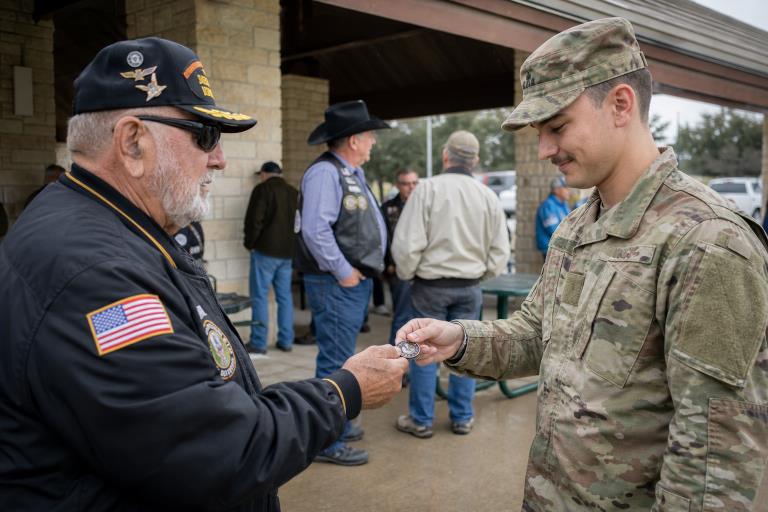
The way a coin is presented often gives it its greatest value. A commander, supervisor, teammate, or organization may offer one after a demanding project, an act of leadership, a successful training event, or meaningful support to a military community.
Common presentation settings include unit ceremonies, graduation events, promotions, retirements, deployment departures and homecomings, memorial observances, veteran reunions, and visits with partner organizations. In a state as connected to military service as Texas, a coin can also serve as a bridge between active-duty personnel, Guard members, veterans, families, and local supporters.
A simple coin attached to a clear moment may be treasured more than an elaborate design with no explanation. When presenting one, say why it is being given, name the contribution being recognized, and let the recipient understand the story they are being asked to carry.
Design Elements That Preserve Meaning
A strong design tells its story at a glance. Trying to fit every motto, date, symbol, and color onto one small surface can make the result hard to read. Start with one central idea, then use the remaining space to support it.
- Symbols: Use imagery that accurately reflects the unit, mission, community, or event.
- Text: Keep names, dates, and mottos short enough to remain legible.
- Shape: A round coin works well for many designs, while a custom outline can reinforce an emblem or Texas-inspired theme.
- Color and depth: Use contrast and raised details to emphasize the most important features.
- Reverse side: Reserve it for a dedication, milestone date, secondary emblem, or brief message.
Before approval, view the artwork at a small size. If the main symbol and message are unclear within a few seconds, simplify the design.
A Practical Design Process
- Define the purpose. Decide whether the coin recognizes service, marks an event, honors a person, or represents membership.
- Verify the details. Confirm spelling, dates, unit references, mottos, and insignia before artwork begins.
- Choose one main idea. Give the front of the coin a focal point rather than several competing themes.
- Plan both sides. Let each side perform a distinct role.
- Review permissions and privacy. Do not use protected insignia without approval or place sensitive details on a public-facing design.
- Request and inspect a proof. Check fine text, color placement, borders, and accuracy before production.
- Allow time. Build in room for revisions, manufacturing, inspection, and delivery before the presentation date.
Challenge Coin Etiquette And Respectful Use
Etiquette differs between units and social groups, including whether a coin-check tradition is used. The safest approach is to ask about local customs rather than assume every group follows the same practice.
- Accept a presented coin with respect and understand the reason for it.
- Do not claim a coin represents service or membership that was never earned.
- Do not confuse a challenge coin with an official award.
- Do not display sensitive mission information or personal details without permission.
- Protect important coins in a case, board, or soft-lined container away from moisture and abrasive objects.
Common Design And Planning Mistakes
Most avoidable problems come from rushing. Common mistakes include crowding the coin with text, using unverified historical details, selecting symbols unrelated to the event, skipping the proof review, and waiting until the ceremony is close to begin planning.
A Texas reunion committee can prevent confusion by assigning one person to verify names, dates, and unit history while another reviews the visual proof. That small division of responsibility protects both the accuracy of the story and the quality of the final coin.
Common Questions About Military Challenge Coins
Who Can Receive A Military Challenge Coin?
Recipients may include service members, veterans, family members, civilian employees, first responders, and partner organizations. The key factor is the presenter’s reason for recognizing service, support, achievement, or connection.
Can Civilians Carry Challenge Coins?
Yes. A civilian who receives a coin as a token of appreciation, partnership, family connection, or community support may carry or display it respectfully.
Should A Coin Include A Person’s Name?
A name can add meaning to retirement, memorial, or individual recognition coins. For designs intended for broad public distribution, consider privacy and whether a name is necessary to tell the story.
Why The Tradition Still Matters In Texas
Military challenge coins remain relevant because they turn recognition into something lasting. In Texas, where military installations, veteran communities, families, and civic supporters often overlap, a coin can preserve the connection between people who served, supported one another, or shared an important moment. The best coin is not always the most elaborate. It is the one that clearly and respectfully honors the story behind it.